What Is Tayammum, When Is It Allowed Before Salah?
Mohd Danish
Founder & Developer
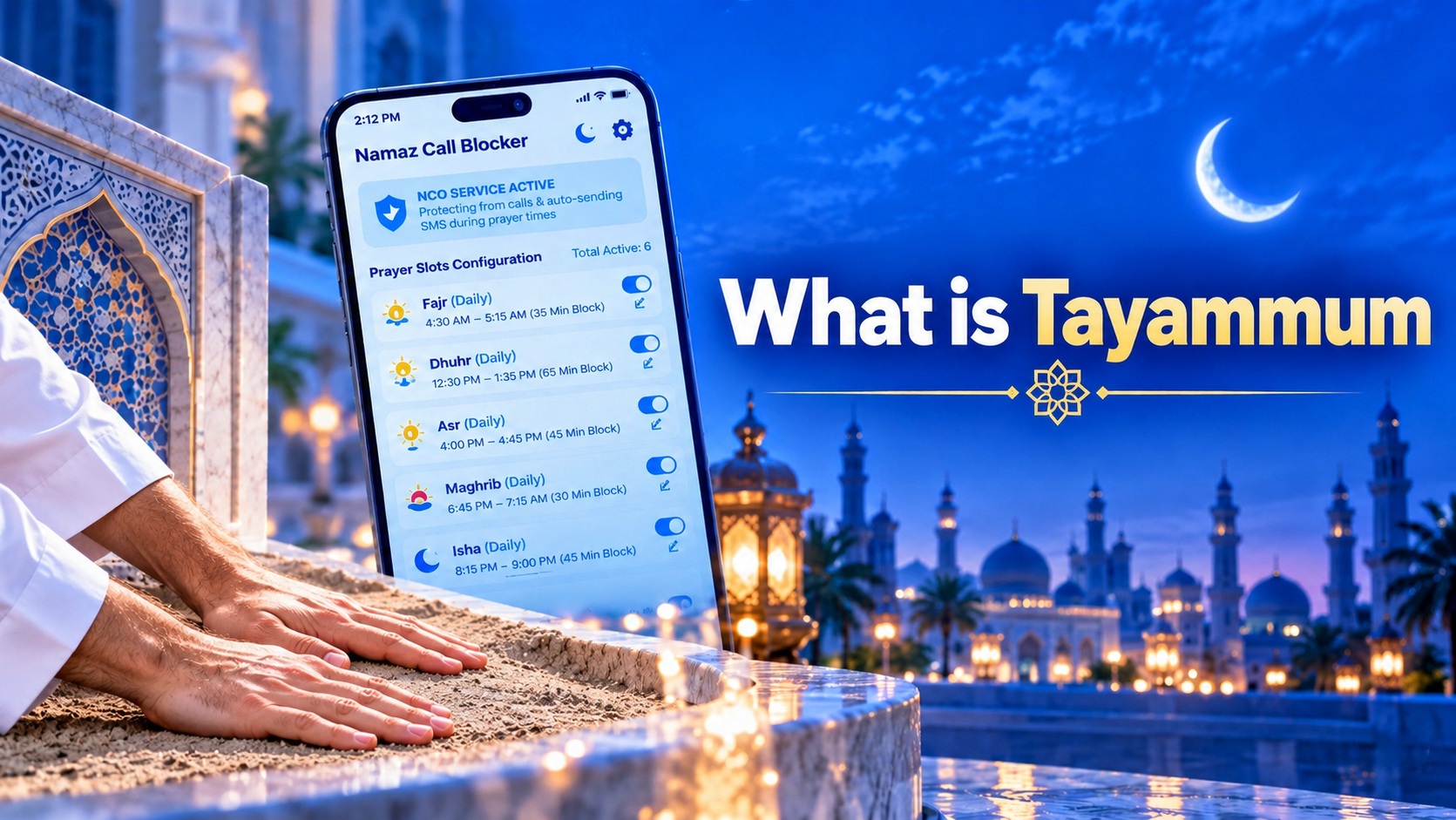
Imagine you are travelling and it is almost time for Salah. You have searched for water, but there is none available. Or perhaps you are recovering from an illness, and using water could make your condition worse.
What should you do?
Islam provides a way to maintain ritual purity even in circumstances like these. It is called Tayammum.
Tayammum allows Muslims to prepare for Salah without water when they have a valid religious reason. It is not an everyday replacement for Wudu or Ghusl. Rather, it is a concession established in the Qur’an and explained through the teachings of Prophet Muhammad (peace be upon him).
Understanding Tayammum is particularly useful for travellers, people experiencing illness and anyone who wants to learn how Islamic purification works in different circumstances.
What Is Tayammum in Islam?
Tayammum is a method of ritual purification performed with clean earth or another permissible material when water cannot be used for a valid reason.
Normally, Muslims perform Wudu before Salah when they need to restore minor ritual purity. Ghusl is required after certain conditions involving major ritual impurity.
However, when water is unavailable or its use would cause genuine harm, Tayammum may take the place of the required water purification.
The Qur’an establishes this permission in Surah Al-Ma’idah.
Allah Subhanahu wa Ta’ala says:
فَتَيَمَّمُوا صَعِيدًا طَيِّبًا فَامْسَحُوا بِوُجُوهِكُمْ وَأَيْدِيكُم مِّنْهُ
Translation (Sahih International, excerpt):
“then seek clean earth and wipe over your faces and hands with it.”
Source: Qur’an 5:6
The verse also discusses Wudu and Ghusl, making it one of the central Qur’anic passages concerning purification.
For readers unfamiliar with these practices, our guides to Wudu and Ghusl explain when each method is required.
Why Does Islam Allow Tayammum?
Water is the normal means of ritual purification, but not everyone has access to it in every situation.
A person may be travelling through a remote area. Someone who is ill may be unable to use water safely. In other circumstances, the only available water may be needed for essential drinking.
Islam recognizes these difficulties.
Near the end of the purification verse, Allah says:
مَا يُرِيدُ اللَّهُ لِيَجْعَلَ عَلَيْكُم مِّنْ حَرَجٍ
Translation (Sahih International, excerpt):
“Allah does not intend to make difficulty for you”
Source: Qur’an 5:6
This is an important part of understanding Tayammum. The permission does not make purification unimportant. Instead, it provides another lawful way to prepare for worship when circumstances prevent the normal method.
The Prophet Muhammad (peace be upon him) also explained that the earth serves as a means of purification when water is unavailable.
Reference: Sahih Muslim 522a
When Is Tayammum Allowed Before Salah?
Tayammum is permitted when the conditions established by Islamic law are met. The most common situations involve unavailable water or a genuine inability to use it.
When You Cannot Find Water
Consider someone travelling far from a town or village. Salah time arrives, but there is no accessible water.
If the person has made the reasonable effort required to find water and none is available, Tayammum may be performed.
The amount of searching required depends on the circumstances and the school of Islamic law being followed.
However, a person should not choose Tayammum simply to avoid the effort of using water that is readily available.
When Water Could Harm Your Health
Some people cannot safely use water because of illness, injury or another medical condition.
For example, a person may have a wound that could be seriously affected by washing. Another person may face a genuine risk of worsening an illness.
Islamic law recognizes circumstances in which water use would cause harm.
Nevertheless, being ill does not automatically mean that Tayammum is permitted. The relevant question is whether the required use of water would cause genuine harm or cannot reasonably be managed.
Where possible, a person should consider appropriate medical advice and reliable religious guidance.
When Water Is Needed for Drinking
Suppose a traveller has a small amount of water remaining and no reliable way to obtain more.
If using that water for purification would leave the traveller or someone dependent on them without necessary drinking water, Tayammum may be permitted.
Preserving essential needs is an important consideration in Islamic jurisprudence.
When Water Cannot Be Accessed Safely
Sometimes water exists nearby, but a person cannot reach or use it safely.
The situation might involve a serious physical limitation or a genuine danger.
Islamic scholars consider the nature of the difficulty when determining whether Tayammum is allowed.
The important distinction is between a real obstacle and ordinary inconvenience.
How to Perform Tayammum According to the Sunnah
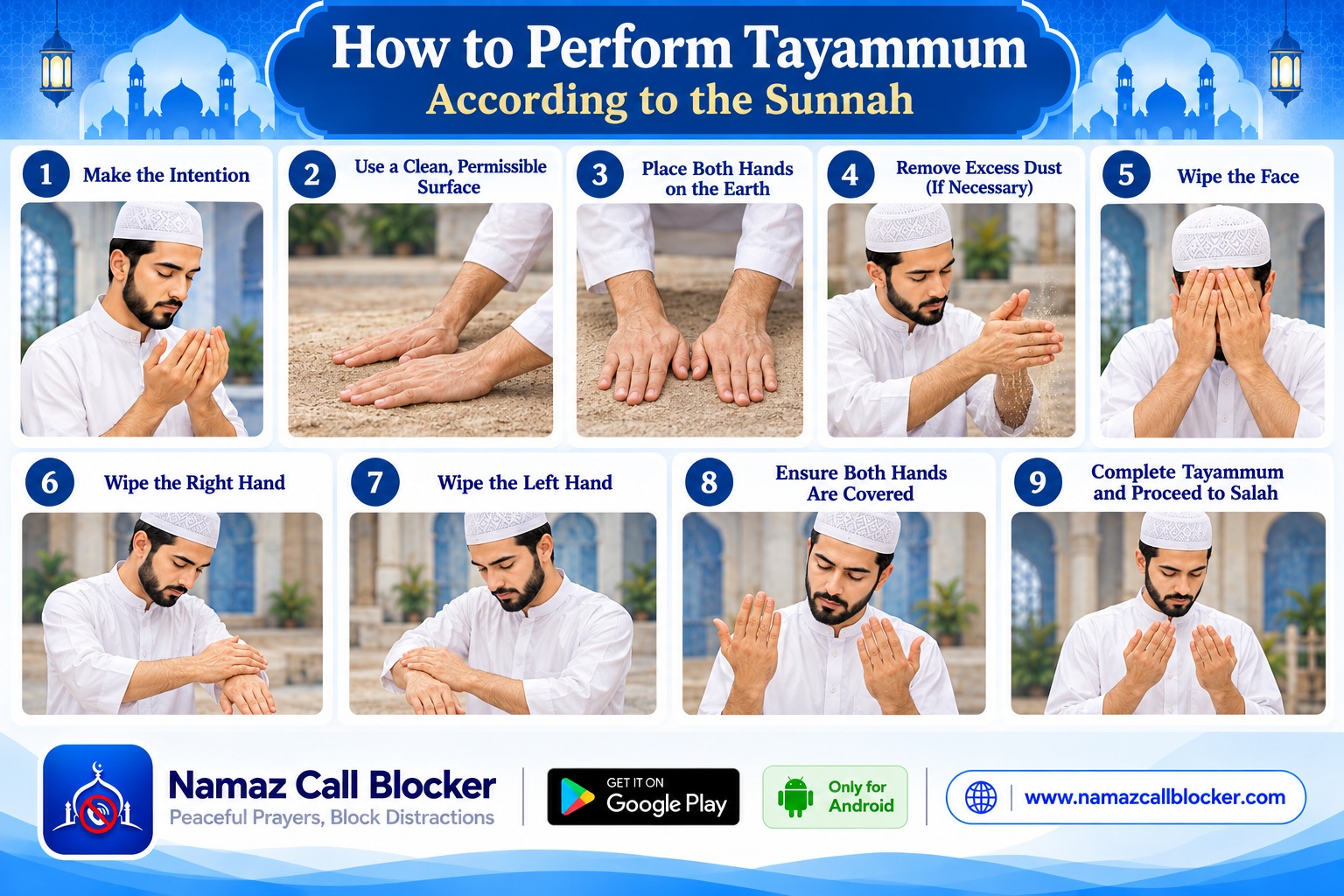
One of the clearest descriptions of Tayammum comes from the account of Ammar ibn Yasir (may Allah be pleased with him).
He asked Prophet Muhammad (peace be upon him) about purification without water. The Prophet demonstrated Tayammum by touching the earth and wiping his face and hands.
Reference: Sahih al-Bukhari 343
The following explanation describes the method found in this narration. Some details differ among the Sunni schools of law.
Step 1: Make Your Intention
Begin with the intention to perform Tayammum for the required purification.
The intention belongs in the heart. You do not need to recite a special Arabic sentence aloud.
Step 2: Find a Clean, Permissible Surface
Use clean earth or another surface accepted by your school of law.
Natural soil is a common example.
However, not every school treats sand, stone, walls and dust-covered surfaces identically. If you follow a particular madhhab, learn which materials it permits.
Step 3: Touch the Earth With Both Hands
Place or lightly strike both palms against the clean surface.
The narration of Ammar describes a single contact with the earth.
Step 4: Remove Excess Dust
If necessary, lightly blow or shake away excess loose dust.
The Hadith narrations include descriptions of removing excess dust from the hands.
Step 5: Wipe Your Face
Pass your hands over your face.
Take care to cover the area required by your school of law.
Step 6: Wipe Your Hands
Wipe your hands as described in the authentic narration.
The one-contact method demonstrated to Ammar includes wiping the face and hands. However, some schools require wiping up to the elbows and prescribe two contacts with the earth.
Important: This explanation should not be understood as a single method accepted in every detail by all four Sunni madhhabs.
Do All Four Sunni Schools Perform Tayammum the Same Way?
The Hanafi, Shafi’i, Maliki and Hanbali schools agree that Tayammum is permitted under valid circumstances. However, they differ on certain requirements.
| School | General approach |
|---|---|
| Hanafi | Wiping the face and both arms including the elbows, generally with two contacts |
| Shafi’i | Wiping the face and both arms including the elbows, generally with two contacts and qualifying earth dust |
| Maliki | Wiping the face and hands, with distinctions between obligatory and recommended details |
| Hanbali | Wiping the face and hands, generally following the one-contact narration |
These are simplified summaries, not complete instructions for every school.
For example, the schools also differ concerning suitable surfaces, the timing of Tayammum and whether one Tayammum can be used for multiple obligatory prayers.
A person who follows a particular school should learn its full method from a reliable teacher or scholarly reference.
Can Tayammum Replace Ghusl?
Yes. Tayammum may replace Ghusl when major ritual purification is required but a valid excuse prevents using water.
For example, a person may need Ghusl after Janabah but be unable to obtain water.
In that situation, Tayammum can serve as the lawful alternative until the excuse ends.
This does not mean Ghusl is permanently unnecessary. When the person can use water again, the applicable requirements of water purification return.
Our article What Is Ghusl, When Is It Necessary Before Salah? explains the circumstances requiring Ghusl and the method reported in authentic Hadith.
What Invalidates Tayammum?
Tayammum does not remain valid in every situation.
First, actions that invalidate the relevant ritual purity generally affect Tayammum as well. For instance, passing urine or wind invalidates minor ritual purity.
Second, when a person can use water again and the reason for Tayammum has ended, the normal requirements of Wudu or Ghusl return.
However, the precise consequences depend on the circumstances.
There are also differences among the schools concerning prayer times and renewal of Tayammum.
For example, the Hanafi school generally permits multiple obligatory prayers with one valid Tayammum. The Shafi’i school generally requires a separate Tayammum for each obligatory prayer.
Therefore, it is important to follow the rules applicable to your school rather than assuming every Muslim follows the same details.
What If You Find Water After Completing Salah?
This is a question that travellers may face.
Imagine that you searched for water, could not find any, performed valid Tayammum and completed your Salah. Shortly afterward, you discovered a water source.
Would you need to repeat the prayer?
An account recorded in Sunan Abi Dawud describes two men who prayed with Tayammum when water was unavailable.
Later, they found water. One repeated his prayer, while the other did not.
The Prophet Muhammad (peace be upon him) approved the action of the person who had not repeated the prayer.
Reference: Sunan Abi Dawud 338
The narration supports the general principle that a Salah completed with valid Tayammum does not need to be repeated merely because water becomes available afterward.
However, specific circumstances and differences among schools may affect individual rulings.
Tayammum, Wudu and Ghusl: What Is the Difference?
These three forms of purification have different purposes.
| Purification | When it is used | How it is performed |
|---|---|---|
| Wudu | When minor ritual purification is required | Washing and wiping prescribed body parts with water |
| Ghusl | When major ritual purification is required | Washing the entire body according to Islamic requirements |
| Tayammum | When a valid excuse prevents required water purification | Wiping the face and hands using a permissible earth-based material |
Tayammum is not a fourth daily prayer ritual or an optional replacement whenever someone prefers not to use water.
It exists to make lawful purification possible when the normal method cannot be performed.
Common Questions People Have About Tayammum
Can I perform Tayammum simply because I am running late for Salah?
Being late by itself is not a general permission to replace available water with Tayammum. Some exceptional circumstances involve detailed scholarly differences, so they should not be reduced to a universal rule.
Can I perform Tayammum on a wall?
That depends on the wall’s material and the school of law you follow. Certain earth-based surfaces may qualify, while other schools require qualifying dust.
Does Tayammum require visible dust on my hands?
Not every school has the same requirements concerning dust and the surface used. Follow the conditions of your madhhab.
Can Tayammum be used for more than one Salah?
The answer differs among schools. Some generally allow multiple obligatory prayers with one valid Tayammum, while others require renewal for each obligatory prayer.
Can a sick person perform Tayammum at home?
Yes, if the illness creates a valid religious reason not to use water. Merely being at home or feeling unwell is not enough by itself.
Is Tayammum valid without an intention?
Intention is an essential part of Tayammum in the major Sunni schools. The details of its timing and formulation may differ.
Preparing for Salah in Everyday Life

Tayammum reminds us that preparation for Salah is not always the same for everyone.
A person praying at home may have easy access to water. A traveller may need to search for it. Someone recovering from an illness may need a different approach.
In each case, the aim is to worship Allah while following the purification requirements that apply to the situation.
Once purification is complete, it is also worth giving some attention to the environment in which we pray.
For example, mobile calls and notifications can interrupt concentration. Our article How Your Mobile Can Disturb Your Namaz discusses simple ways to reduce these distractions.
For Android users, Namaz Call Blocker offers optional tools to manage incoming calls during configured Salah times, including call rejection, SMS replies and sound settings.
These tools are not part of Islamic purification. They are simply practical options for people who want fewer phone interruptions while praying.
Conclusion
Tayammum is a practical and meaningful part of Islamic purification.
It allows Muslims to prepare for Salah when water is unavailable or cannot be used for a valid reason. The Qur’an establishes this permission, and authentic Hadith describe how Prophet Muhammad (peace be upon him) performed Tayammum.
Although the main principle is clear, some details differ among Islamic schools of law. Learning those differences helps Muslims avoid confusion and practise their faith with confidence.
Perhaps the most important lesson is that Islamic worship takes real human circumstances into account. Purification remains important, but Allah has provided a lawful alternative when genuine difficulty arises.
Qur’an and Authentic Hadith References
| Reference | Subject |
|---|---|
| Qur’an 5:6 | Water purification, Tayammum and removal of hardship |
| Qur’an 4:43 | Permission for Tayammum |
| Sahih al-Bukhari 339 | Description of Tayammum |
| Sahih al-Bukhari 343 | Demonstration to Ammar ibn Yasir |
| Sahih Muslim 522a | Earth as a means of purification |
| Sunan Abi Dawud 338 | Finding water after completing Salah |
This article is intended for general Islamic education. Detailed rulings vary among Sunni schools. For personal circumstances involving illness, prayer validity or uncertainty about purification, consult a qualified scholar.