How Your Mobile Can Disturb Your Namaz
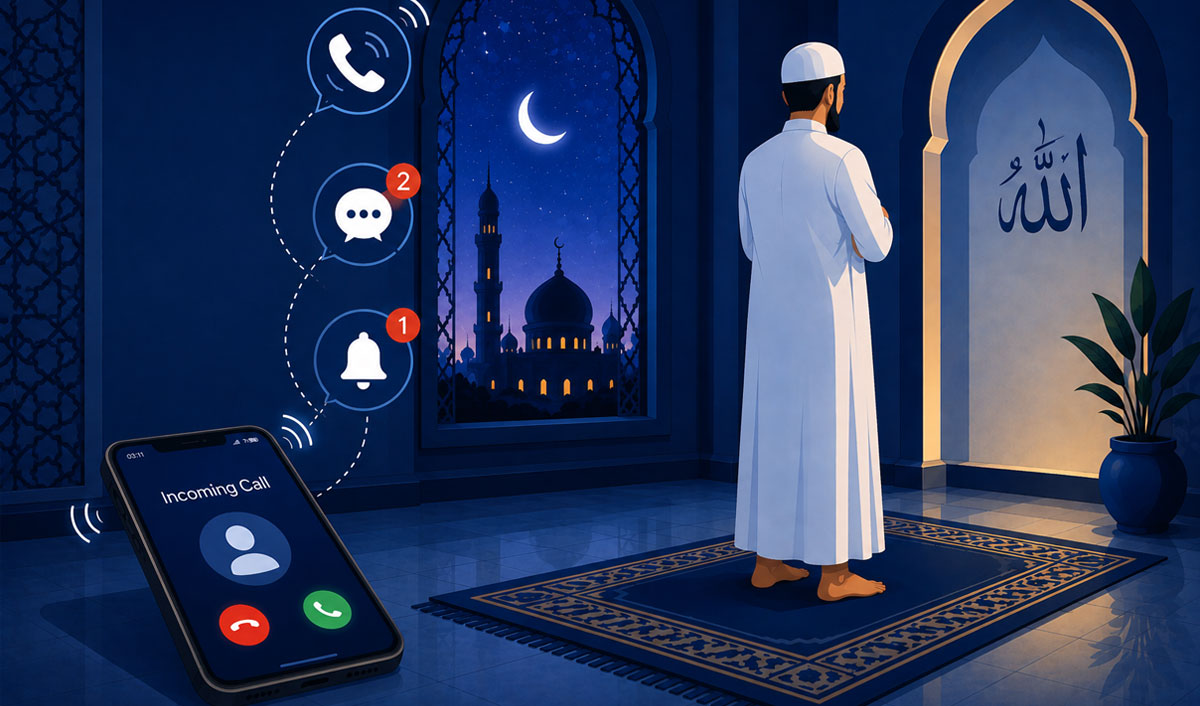
Mobile phones have become an essential part of modern life. We use them for communication, work, education, business, entertainment, and staying connected with family and friends. But because we use them so frequently, they can also demand our attention at almost any moment — and this is exactly how your mobile can disturb your Namaz if we’re not mindful of it.
Namaz is one of the moments when our attention should be directed toward worship. If you’re new to why this time matters so much, our earlier post on the importance of Namaz in Islam covers that foundation in more depth.
Why Your Mobile Can Become a Distraction During Namaz
Allah says in the Qur’an that prayer has been established for His remembrance (Qur’an 20:14).
Namaz gives a Muslim an opportunity to step away from everyday activities and remember Allah. However, a ringing phone, vibration, notification, or illuminated screen can pull our attention back toward worldly matters.
Sometimes the distraction is only a few seconds long. A phone rings, and immediately we start wondering who is calling. Is it family? Is it work? Is it urgent? Should we check it after the prayer?
Even if we do not touch the phone, these thoughts can affect our concentration.
This does not mean that every distraction makes a person’s Namaz invalid — matters concerning the validity of prayer depend on individual circumstances and are best addressed with a qualified scholar rather than general guidance like this. The simple, gentle lesson here is that reducing unnecessary distractions can help us approach Namaz with a little more presence and attention.
What the Quran and Sunnah Teach About Focus in Prayer
The importance of being attentive during prayer can be understood from the Qur’an and Sunnah.
In Surah Al-Mu’minun, Allah describes believers who are humble in their prayer, and Qur’an 23:1–2 connects success with this quality of humility during Salah.
Another example comes from the life of Prophet Muhammad ﷺ (peace be upon him). In Sahih al-Bukhari 373, Aisha رضي الله عنها reported that the Prophet ﷺ (peace be upon him) once prayed while wearing a garment with markings, noticed those markings during the prayer, and afterward asked for a different garment because they had drawn his attention away.

This Hadith isn’t about mobile phones — they didn’t exist at the time — but it offers a helpful example of how something ordinary in our surroundings can quietly pull focus during Salah. Today, the distractions simply look different: a ringtone, a vibration in the pocket, a notification lighting up the screen.
None of this means modern technology is forbidden or that every interruption is sinful. It’s simply worth considering, with kindness toward ourselves, what unnecessary elements we might gently remove from our prayer environment.
How Calls and Notifications Can Affect Your Namaz
A phone can disturb Namaz in a few different ways.
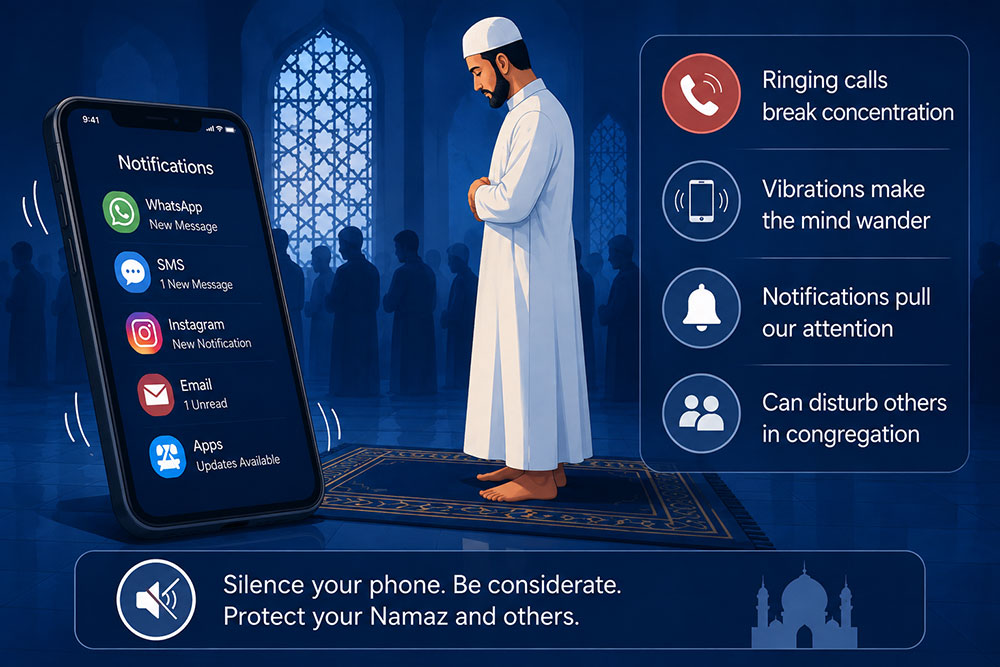
The most obvious is a ringing call. If you’re praying alone, the ringtone may break your concentration. If you’re praying in a mosque, it may also draw the attention of people praying around you.
A phone on silent mode can still create another problem: vibration. When a phone buzzes repeatedly in a pocket, it can be hard to ignore, and your mind may drift to wondering who’s calling or whether it’s important.
Notifications create a similar pull. A WhatsApp message, SMS, email, social media alert, or app reminder may light up the screen or make a sound — and even when it isn’t urgent, our minds naturally want to know what happened. Smartphones are, after all, designed to keep us engaged.
Namaz offers a rare, regular chance to step away from that constant stream of information.
There’s also a matter of consideration for others. In congregational prayer, a phone doesn’t affect only its owner — a loud ringtone can disturb the person praying next to you too. Checking your phone before Namaz and silencing unnecessary sounds is a simple, considerate habit for everyone sharing that space.
Simple Ways to Reduce Mobile Distractions During Namaz
Reducing phone distractions doesn’t require complicated technology — a few simple habits go a long way.
Silence your phone before Namaz : Take a few seconds to make sure your ringtone and unnecessary sounds are off.
Reduce unnecessary notifications : If several apps constantly send alerts, consider turning off the ones you don’t really need.
Avoid checking your phone right before prayer : Scrolling messages until the last moment can make it harder to mentally transition into worship.
Keep your phone out of immediate reach when possible : At home, this might mean placing it in another room. At the mosque, keep it somewhere secure and out of sight.
Plan ahead if you know you’ll be interrupted : If you frequently get calls during Namaz, it helps to decide in advance how you want your phone to behave — whether that’s manually silencing it or using your phone’s built-in Do Not Disturb settings.
The goal isn’t perfection — it’s finding a practical approach that fits your circumstances and gently reduces avoidable interruptions.
Using Technology to Reduce Technology Distractions
Technology itself isn’t always the problem — sometimes it can be part of the solution too.
This is the idea behind Namaz Call Blocker, an Android app that helps users manage incoming calls during their configured Namaz times. Instead of manually adjusting phone settings before every prayer, users can set their Namaz slots once and let the app handle incoming calls accordingly. It also offers an optional SMS feature that sends a predefined message to callers during that window.
The idea is simple: use technology to reduce unnecessary phone interruptions during a time of worship. An app can’t create khushu (presence of heart) on its own, and nothing replaces sincere effort — it’s simply a practical tool for a modern problem, useful for those who find it helpful. The choice to block or manage calls should also fit your own circumstances, since there may be times you genuinely need to stay reachable — so it’s worth configuring both your phone and the app thoughtfully. You can read more about how the app works and why it was built on our About Us page, or reach out through Contact Us if you have questions. Details on how your data is handled are available in our Privacy Policy.
The bigger lesson is simply that we don’t have to let our devices claim every moment of our attention. Allah says in the Qur’an that prayer has been established for His remembrance (Qur’an 20:14) — and when Namaz begins, setting aside unnecessary distractions helps us give it the attention it deserves.
A phone call can wait when circumstances allow. A notification can wait. A message can wait. Namaz deserves our attention.
By building a few simple habits — silencing unnecessary notifications, preparing our phones before prayer, and reducing avoidable interruptions — we can create a calmer, more focused environment for ourselves and for those praying around us.
May Allah help us establish our prayers, increase our humility and attentiveness in Salah, and accept our worship.
Ameen.