What Is Wudu, Why Is It Necessary for Salah?
Mohd Danish
Founder & Developer

Wudu, also known as ablution, is an essential form of ritual purification in Islam. Muslims perform Wudu before Salah when minor ritual purity needs to be restored.
Beyond physical cleanliness, Wudu prepares a Muslim for worship and encourages discipline, mindfulness, and obedience to Allah.
The Qur’an establishes its foundational requirements, while Prophet Muhammad (peace be upon him) demonstrated its practical method.
To understand the importance of prayer, read What Is Salah, Why Is It Important for Muslims?.
What Is Wudu in Islam?
Wudu is a prescribed form of purification involving washing and wiping specific parts of the body. It is part of Taharah, the Islamic concept of purification.
What Does the Qur’an Say About Wudu?
Allah explains the foundational requirements of Wudu in Surah Al-Ma’idah (5:6).
Original Arabic — Relevant Excerpt:
يَا أَيُّهَا الَّذِينَ آمَنُوا إِذَا قُمْتُمْ إِلَى الصَّلَاةِ فَاغْسِلُوا وُجُوهَكُمْ وَأَيْدِيَكُمْ إِلَى الْمَرَافِقِ وَامْسَحُوا بِرُءُوسِكُمْ وَأَرْجُلَكُمْ إِلَى الْكَعْبَيْنِ
English Translation — Sahih International:
O you who have believed, when you rise to [perform] prayer, wash your faces and your forearms to the elbows and wipe over your heads and wash your feet to the ankles.
Qur’an Reference: Surah Al-Ma’idah 5:6
This verse establishes four foundational actions:
- Washing the face.
- Washing the arms, including the elbows.
- Wiping the head.
- Washing the feet, including the ankles.
The same verse also addresses Ghusl and Tayammum.
Why Is Wudu Necessary for Salah?
Salah requires ritual purification. When Wudu is invalidated, it must ordinarily be renewed before prayer.
Prophet Muhammad (peace be upon him) taught that prayer is not accepted after ritual impurity until purification is performed.
Authentic Hadith: Sahih Muslim 225
However, Wudu does not need to be repeated before every Salah if it remains valid.
Spiritual Benefits of Wudu
Wudu is not merely a physical routine.
In Sahih Muslim 244, Prophet Muhammad (peace be upon him) described how sins associated with the eyes, hands, and feet are washed away during Wudu.
Authentic Hadith: Sahih Muslim 244
Another narration describes the reward associated with performing Wudu properly and then praying.
Authentic Hadith: Sahih al-Bukhari 160
These teachings highlight the spiritual significance of purification.
How to Perform Wudu According to the Sunnah
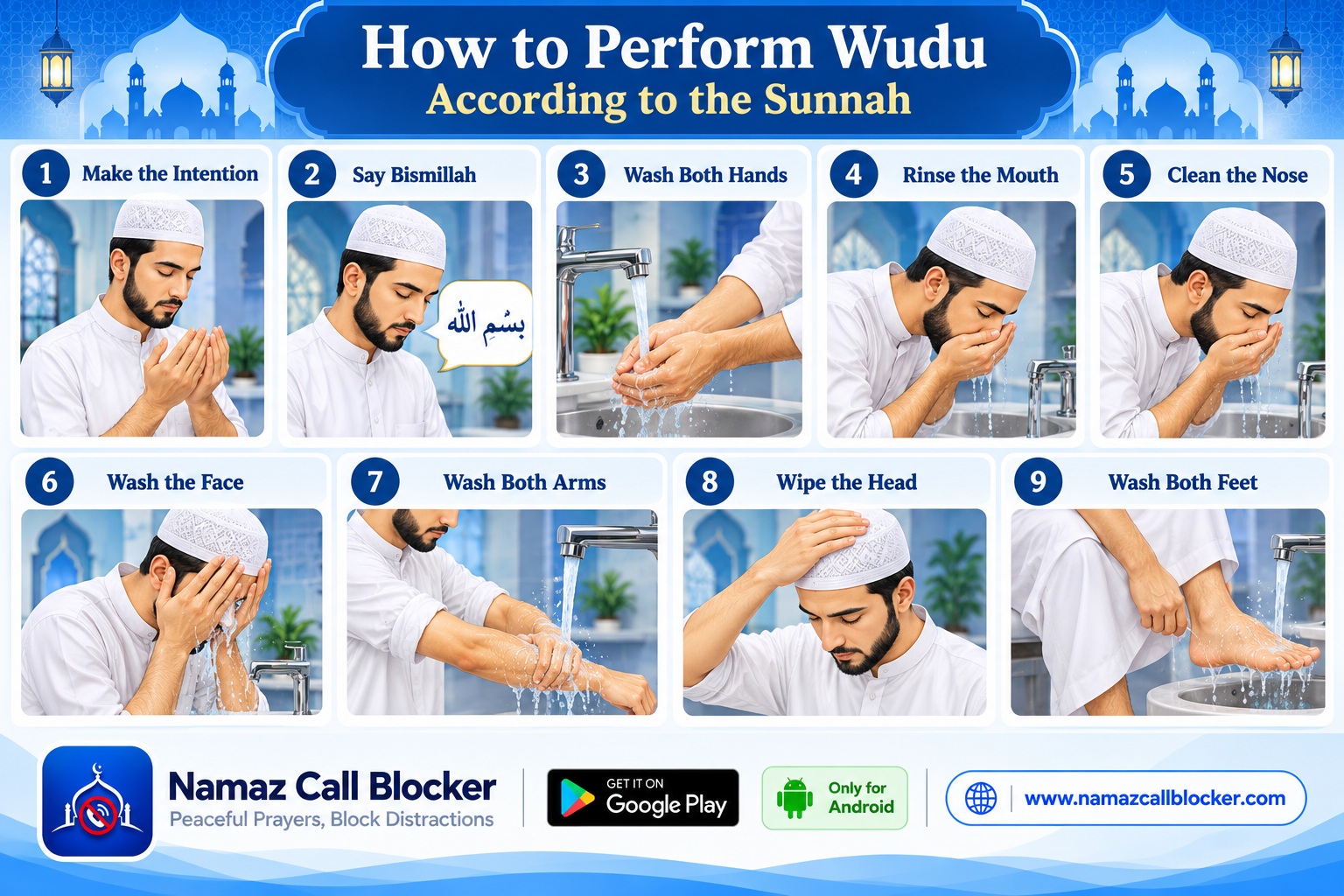
Uthman ibn Affan (may Allah be pleased with him) demonstrated Wudu as performed by Prophet Muhammad (peace be upon him).
Primary Hadith: Sahih al-Bukhari 159
Follow these steps:
Step 1: Make the Intention
Intend to perform Wudu for purification. Intention is fundamentally an act of the heart, and a fixed spoken formula is not universally required.
Step 2: Say Bismillah
Begin by saying:
بِسْمِ اللَّهِ
Bismillah — In the name of Allah.
Scholars differ regarding its legal status.
Reference: Sunan Abi Dawud 101
Step 3: Wash Both Hands
Wash both hands up to the wrists three times.
Step 4: Rinse the Mouth
Rinse the mouth with water.
Step 5: Clean the Nose
Gently draw water into the nostrils and expel it.
Step 6: Wash the Face
Wash the entire required area of the face, preferably three times.
Step 7: Wash Both Arms
Wash both arms, including the elbows, preferably three times.
Step 8: Wipe the Head
Pass wet hands over the head.
An authentic narration describes wiping from the front toward the back and returning to the starting position.
Reference: Sahih al-Bukhari 185
Step 9: Wash Both Feet
Wash both feet, including the ankles, preferably three times. Ensure water reaches the heels and between the toes.
Important: Washing three times is an established Sunnah practice, but one complete washing fulfills the basic washing obligation.
Reference: Sahih al-Bukhari 157
What Are the Obligatory Requirements of Wudu?
Surah Al-Ma’idah 5:6 establishes four foundational actions: washing the face, washing the arms including the elbows, wiping the head, and washing the feet including the ankles.
The complete legal requirements differ among the Hanafi, Shafi’i, Maliki, and Hanbali schools.
Differences include the status of intention, sequence, continuity, rinsing the mouth and nose, and the minimum extent of wiping the head.
Muslims should follow reliable guidance consistent with their recognized school of jurisprudence.
What Invalidates Wudu?
The following are recognized causes of Wudu becoming invalid:
- Urination or defecation.
- Passing wind.
- Loss of consciousness.
- Sleep, subject to the circumstances and relevant jurisprudential rulings.
Hadith Reference: Sahih al-Bukhari 135
Other matters, including bleeding, vomiting, physical contact, and touching private parts, are treated differently among Islamic schools.
Does Doubt Break Wudu?
Mere uncertainty does not automatically invalidate Wudu.
Prophet Muhammad (peace be upon him) gave guidance about a person who was unsure whether they had passed wind.
Authentic Hadith: Sahih Muslim 362
The important distinction is between confirmed invalidation and mere doubt.
Common Mistakes During Wudu
Some common mistakes include:
- Leaving parts of the elbows, heels, ankles, or feet dry.
- Performing Wudu so quickly that required areas are missed.
- Assuming every body part must be washed three times for Wudu to be valid.
- Using excessive water.
- Confusing recommended Sunnah practices with obligatory requirements.
A narration in Sahih Muslim describes a person who was instructed to repeat Wudu after leaving part of his foot unwashed.
Authentic Hadith: Sahih Muslim 243
Can Muslims Wipe Over Socks During Wudu?
Authentic Hadith establish that Prophet Muhammad (peace be upon him) wiped over khuffayn, a form of qualifying footwear.
Authentic Hadith: Sahih al-Bukhari 206
However, not every ordinary sock automatically qualifies. Conditions differ among Islamic schools, so appropriate scholarly guidance should be followed.
Wudu vs Ghusl vs Tayammum
| Purification | Purpose |
|---|---|
| Wudu | Restores minor ritual purity |
| Ghusl | Removes major ritual impurity |
| Tayammum | An alternative purification method when its conditions are fulfilled |
All three are addressed in the Qur’an, including Surah Al-Ma’idah 5:6.
Preparing for Salah After Wudu
Along with valid purification, Muslims should ensure that the Salah time has begun, their clothing and prayer area meet the relevant requirements, and they are facing the Qiblah.
Avoiding unnecessary interruptions can also help maintain concentration during prayer.
Stay Focused During Salah with Namaz Call Blocker

Salah App – Namaz Call Blocker (NCB) is a free Android application designed to reduce incoming-call interruptions during selected Salah times.
Its features include automatic call rejection, optional SMS replies, silent or vibrate mode, and automatic restoration of previous sound settings.
Core features can work without an internet connection, subject to device compatibility and required permissions.
Free to Use | No Internet Required for Core Features | No Ads | Only for Android
Official Website: Salah App – Namaz Call Blocker
The application is a practical convenience, not a religious requirement for Wudu or Salah.
Frequently Asked Questions About Wudu
Is Wudu Required Before Every Salah?
No. Wudu can be used for multiple prayers as long as it remains valid.
Can I Pray Without Wudu?
Salah requires the appropriate ritual purification. Tayammum may be permitted when its conditions are fulfilled.
Is Washing Three Times Obligatory?
No. One complete washing fulfills the basic washing obligation for the required areas.
Does Sleeping Break Wudu?
It depends on the circumstances and the relevant school of jurisprudence.
Does Bleeding Break Wudu?
Recognized Islamic schools differ on this ruling.
Can I Perform Wudu While Wearing Socks?
Wiping over qualifying footwear is permitted under specific conditions, which differ among Islamic schools.
Conclusion
Wudu is an essential form of purification in Islam. The Qur’an establishes its foundational requirements, while authentic Hadith explain how Prophet Muhammad (peace be upon him) performed it.
Understanding Wudu and what invalidates it helps Muslims prepare correctly for Salah.
Beyond physical cleanliness, Wudu reminds us of sincerity, discipline, and obedience to Allah.
Perform Wudu with knowledge and approach Salah with sincerity.
Qur’an and Authentic Hadith References
| Reference | Subject |
|---|---|
| Qur’an 5:6 | Requirements of Wudu |
| Sahih Muslim 225 | Purification before Salah |
| Sahih Muslim 244 | Spiritual benefits of Wudu |
| Sahih al-Bukhari 159 | Sunnah method of Wudu |
| Sahih al-Bukhari 157 | Washing once |
| Sahih al-Bukhari 160 | Reward associated with Wudu and prayer |
| Sahih al-Bukhari 185 | Wiping the head |
| Sahih al-Bukhari 135 | Wudu after ritual impurity |
| Sahih Muslim 362 | Doubt about Wudu |
| Sahih Muslim 243 | Washing required areas |
| Sahih al-Bukhari 206 | Wiping over qualifying footwear |
| Sunan Abi Dawud 101 | Mentioning Allah’s name |
Educational note: This article explains common Sunni foundations of Wudu. Certain rulings differ among recognized schools of Islamic jurisprudence. Consult a qualified Islamic scholar for school-specific guidance.