What Is Ghusl, When Is It Necessary Before Salah?
Mohd Danish
Founder & Developer
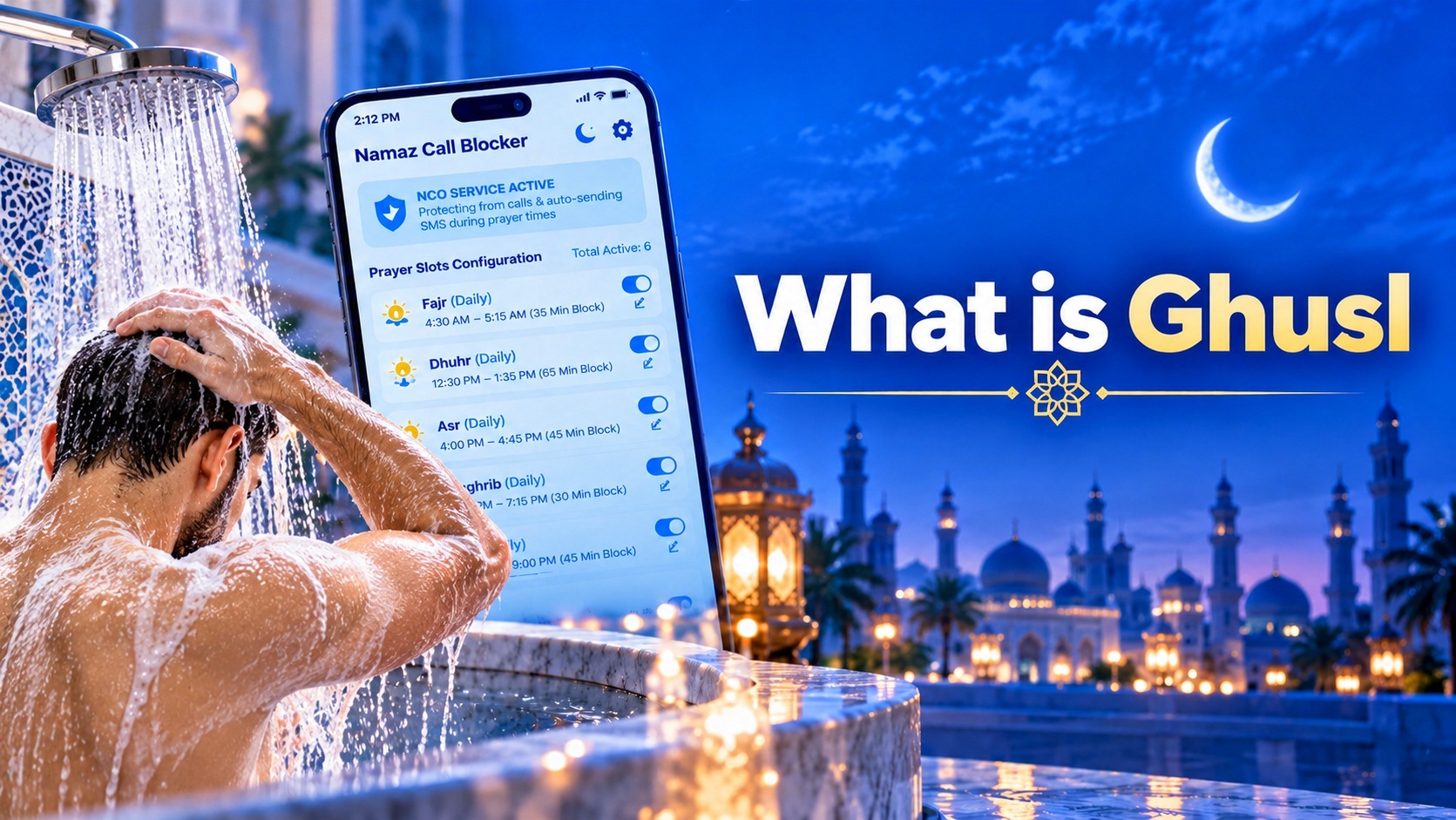
Islam places great importance on cleanliness and purification. Before offering Salah, Muslims must ensure that they meet the requirements of ritual purity.
Sometimes, Wudu is enough. However, certain situations require a complete ritual bath called Ghusl.
Salah is one of the Five Pillars of Islam. Therefore, understanding purification helps Muslims prepare for this important act of worship.
What Is Ghusl in Islam?
Ghusl is an Islamic ritual bath that removes major ritual impurity (Janabah or Hadath Akbar). It involves washing the entire body according to Islamic requirements.
Unlike an ordinary shower, Ghusl is an act of ritual purification. Therefore, its purpose goes beyond physical cleanliness.
Allah Subhanahu wa Ta’ala says in the Qur’an:
وَإِن كُنتُمْ جُنُبًا فَاطَّهَّرُوا
Translation (Sahih International): “And if you are in a state of janabah, then purify yourselves.”
Source: Surah Al-Ma’idah 5:6
This verse establishes the importance of purification from major ritual impurity.
Why Is Ghusl Necessary Before Salah?
Salah requires ritual purity. While Wudu removes minor ritual impurity, Ghusl removes major ritual impurity.
For example, someone who enters a state of Janabah must perform Ghusl before offering Salah.
However, Ghusl is not necessary before every prayer. A Muslim only needs it when a condition requiring major purification occurs.
To understand the importance of prayer, read our article: What Is Salah, Why Is It Important for Muslims?.
If someone cannot use water because of a valid religious excuse, Islamic law provides the alternative of Tayammum under its prescribed conditions.
When Does Ghusl Become Obligatory?
Several circumstances require Ghusl.
1. After Sexual Intercourse
Ghusl becomes obligatory after sexual intercourse, even when ejaculation does not occur.
The Prophet Muhammad (peace be upon him) explained this ruling in an authentic narration.
Reference: Sahih Muslim 349
2. After Ejaculation
Ghusl is generally required when semen is discharged under circumstances that establish Janabah.
For example, if someone experiences a wet dream and finds evidence of seminal discharge upon waking, Ghusl becomes necessary.
However, merely seeing a dream without finding such evidence does not automatically require Ghusl.
Reference: Sahih al-Bukhari 282
3. After Menstruation Ends
A Muslim woman must perform Ghusl after her menstrual period ends before resuming Salah.
Allah says:
وَيَسْأَلُونَكَ عَنِ الْمَحِيضِ
Translation (Sahih International, excerpt): “And they ask you about menstruation.”
Source: Surah Al-Baqarah 2:222
The verse addresses menstruation and purification. Authentic Hadith also explain the requirement to perform Ghusl after menstruation.
Reference: Sahih al-Bukhari 320
4. After Postnatal Bleeding Ends
After postnatal bleeding (Nifas) ends, a Muslim woman performs Ghusl before resuming Salah.
The detailed rulings concerning the duration of Nifas and its end can differ among Islamic schools of law.
How to Perform Ghusl According to the Sunnah
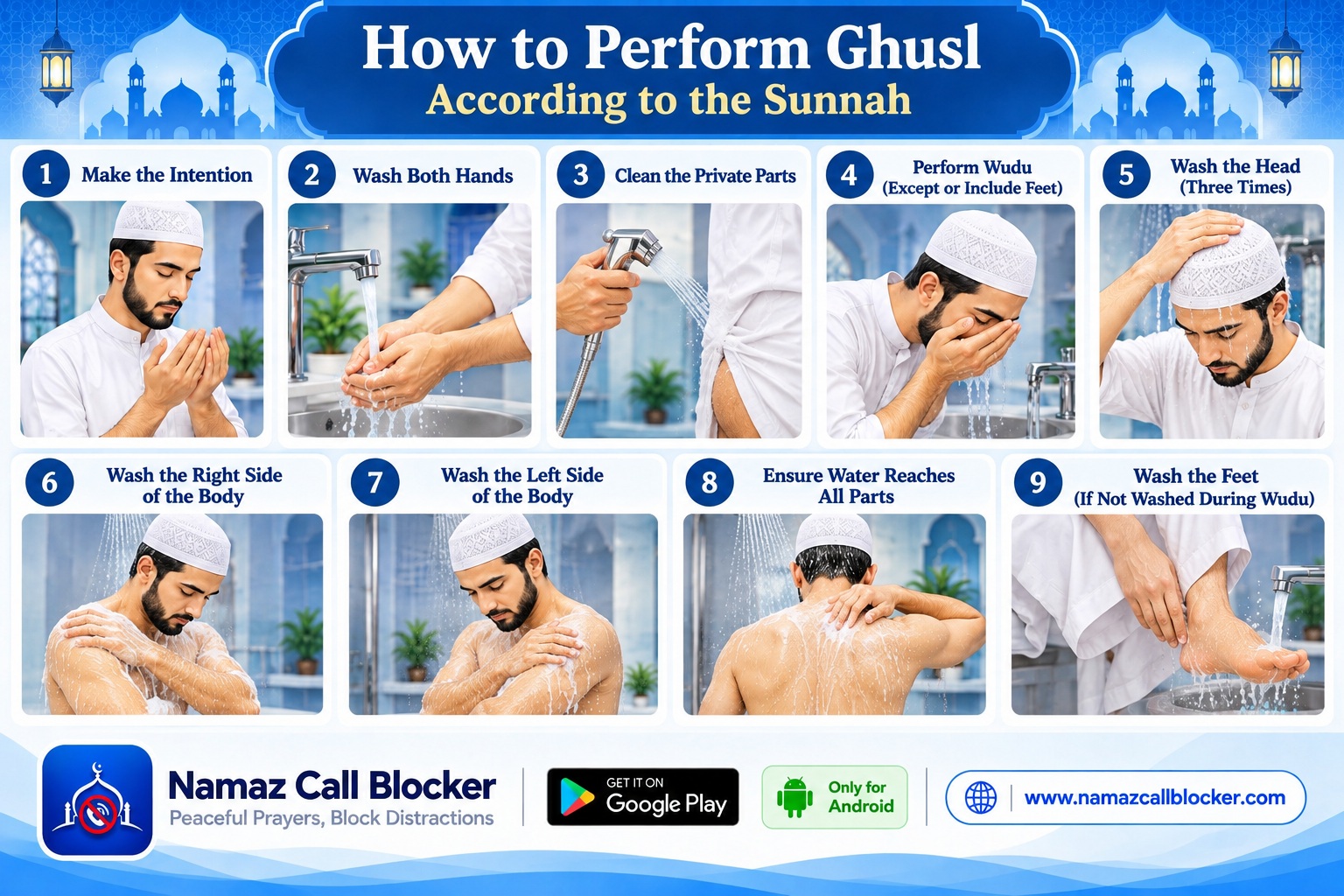
The Prophet Muhammad (peace be upon him) demonstrated a complete method of Ghusl.
Aisha (may Allah be pleased with her) described how he performed Ghusl after Janabah.
References: Sahih al-Bukhari 248 and Sahih Muslim 316
Follow these steps to understand the Sunnah method.
Step 1: Make the Intention
Begin with the intention to remove major ritual impurity and perform Ghusl for purification.
The intention belongs in the heart. You do not need to recite a specific Arabic formula aloud.
Scholars differ on whether intention is a condition for the validity of Ghusl, so follow the guidance of your school of law.
Step 2: Wash Both Hands
Wash both hands thoroughly.
The Prophet Muhammad (peace be upon him) began his Ghusl by washing his hands.
Step 3: Wash the Private Parts
Clean the private parts and remove any physical impurity.
This prepares the body for the remaining steps.
Step 4: Perform Wudu
Perform Wudu as you would before Salah.
In some authentic narrations, the Prophet Muhammad (peace be upon him) delayed washing his feet until the end of Ghusl.
You can also read our guide: What Is Wudu, Why Is It Necessary for Salah?.
Step 5: Wash the Head
Pour water over the head and ensure that it reaches the roots of the hair.
The Sunnah narrations describe pouring water over the head three times.
Step 6: Wash the Entire Body
Wash the entire body thoroughly.
Begin with the right side, followed by the left, as described in the Sunnah.
Ensure that water reaches areas that people sometimes overlook, including the armpits, skin folds and spaces around the ears.
Step 7: Wash the Feet if Necessary
If you delayed washing your feet during Wudu, wash them now.
Your Ghusl is complete once you have fulfilled its requirements.
Important: These steps describe the Sunnah method. Not every individual step is obligatory according to every madhhab.
What Are the Obligatory Requirements of Ghusl?
The minimum requirements differ among the four major Sunni schools of Islamic jurisprudence.
| School of Law | Important Requirements |
|---|---|
| Hanafi | Rinsing the mouth, rinsing the nose and washing the entire body |
| Shafi’i | Intention and ensuring water reaches the entire body, including the hair |
| Maliki | Intention, washing the entire body, rubbing the body and continuity, subject to school-specific details |
| Hanbali | Intention and washing the entire body, including rinsing the mouth and nose |
These are simplified summaries. For example, scholars discuss details such as hair, body folds, the sequence of actions and uninterrupted washing.
Therefore, Muslims should consult qualified scholars for guidance specific to their madhhab.
Ghusl vs Wudu: What Is the Difference?
Although both involve purification, Ghusl and Wudu serve different purposes.
| Feature | Wudu | Ghusl |
|---|---|---|
| Purpose | Removes minor ritual impurity | Removes major ritual impurity |
| Method | Washing and wiping specific body parts | Washing the entire body according to Islamic requirements |
| Required before Salah | When minor ritual purity needs restoration | When major ritual purification is necessary |
| Examples | After passing urine or wind | After Janabah or the end of menstruation |
In simple terms: Wudu prepares a Muslim for Salah when minor ritual purity is needed. Ghusl becomes necessary when major ritual impurity must be removed.
Can You Perform Salah After Ghusl Without Wudu?
In general, a valid Ghusl performed to remove major ritual impurity can also fulfill the requirements of Wudu.
However, this depends on fulfilling the applicable conditions and not doing anything that invalidates purification.
Some details differ among madhhabs, particularly regarding intention and whether the Ghusl was obligatory or voluntary.
Therefore, follow the rulings of your school of law when deciding whether a separate Wudu is necessary.
Common Mistakes to Avoid During Ghusl
People sometimes make mistakes because they confuse an ordinary shower with ritual purification.
Here are some important points:
- Ensure water reaches the entire body, including areas that are easy to overlook.
- Do not assume that using soap or shampoo is a religious requirement for Ghusl.
- Follow your madhhab’s ruling on rinsing the mouth and nose.
- Remove substances that prevent water from reaching the skin when required.
- Avoid wasting water. Islam encourages moderation, even during purification.
A person does not need to repeat Ghusl simply because of an unsupported doubt after completing it.
What If Water Is Unavailable or Harmful?
Islam recognizes situations in which a Muslim cannot use water.
For example, someone may lack access to water or have a medical condition that makes its use harmful.
In such circumstances, Tayammum may replace Ghusl or Wudu when its Islamic conditions are met.
Allah mentions this concession in Surah Al-Ma’idah 5:6.
However, the exact conditions and practical rulings depend on the situation and Islamic school of law.
Prepare for Salah Without Phone Distractions
After completing purification, Muslims can focus on preparing for Salah.
However, incoming calls and phone notifications may interrupt their concentration.
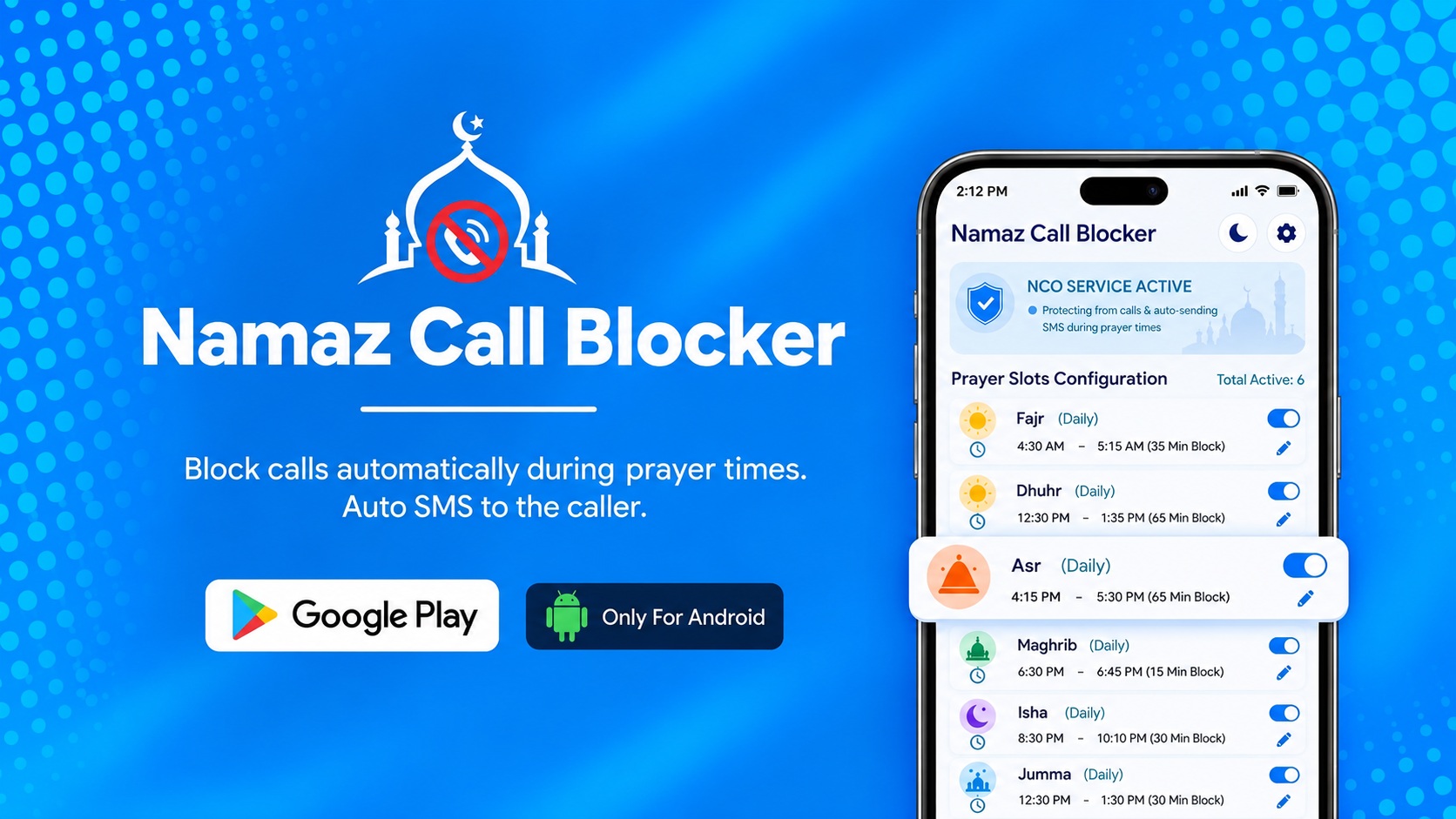
Salah App – Namaz Call Blocker is an Android application designed to help reduce phone-call disturbances during Salah.
Depending on your settings and device permissions, the app offers automatic call rejection, optional SMS replies, silent or vibrate modes and automatic sound restoration.
The app’s core functionality works without an internet connection, and it is free to use without ads.
Visit: Namaz Call Blocker
Available for Android only.
Frequently Asked Questions About Ghusl
1. What is Ghusl in Islam?
Ghusl is a ritual bath that removes major ritual impurity. It involves washing the entire body according to Islamic requirements.
2. Is Ghusl necessary before every Salah?
No. Ghusl is only necessary when a condition requiring major ritual purification occurs. Otherwise, valid Wudu is generally sufficient.
3. Can I perform Ghusl while taking a shower?
Yes. A shower can fulfill Ghusl if you meet all the applicable requirements of your madhhab. Simply standing under water does not automatically establish that every requirement has been met.
4. Is Wudu necessary after Ghusl?
A valid Ghusl for major ritual purification can generally suffice for Wudu. However, the applicable conditions and some details differ among Islamic schools of law.
5. Is soap necessary for Ghusl?
No. Soap and shampoo are not religious requirements for Ghusl. Water must reach the required parts of the body.
6. What should I do if I cannot use water?
If you have a valid religious excuse, Tayammum may be permitted. Consult a qualified scholar for guidance relevant to your circumstances.
Conclusion
Ghusl is an important part of Islamic purification. It allows Muslims to remove major ritual impurity and prepare for Salah.
By learning when Ghusl becomes obligatory and how the Prophet Muhammad (peace be upon him) performed it, Muslims can approach purification with greater understanding.
Above all, remember that Islam teaches both cleanliness and ease. Learn the requirements, follow authentic guidance and avoid unnecessary doubts.
Qur’an and Hadith References
| Source | Subject |
|---|---|
| Qur’an 5:6 | Purification, Ghusl and Tayammum |
| Qur’an 2:222 | Menstruation and purification |
| Sahih Muslim 349 | Ghusl after intercourse |
| Sahih al-Bukhari 282 | Wet dreams and purification |
| Sahih al-Bukhari 320 | Menstruation and resuming Salah |
| Sahih al-Bukhari 248 | The Prophet’s method of Ghusl |
| Sahih Muslim 316 | Description of Ghusl |
Educational note: This article presents general Sunni Islamic teachings. Detailed rulings may differ among the Hanafi, Shafi’i, Maliki and Hanbali schools. Consult a qualified scholar for personal religious questions.