Things to Know Before Praying Salah: The Sunnah Way
Mohd Danish
Founder & Developer
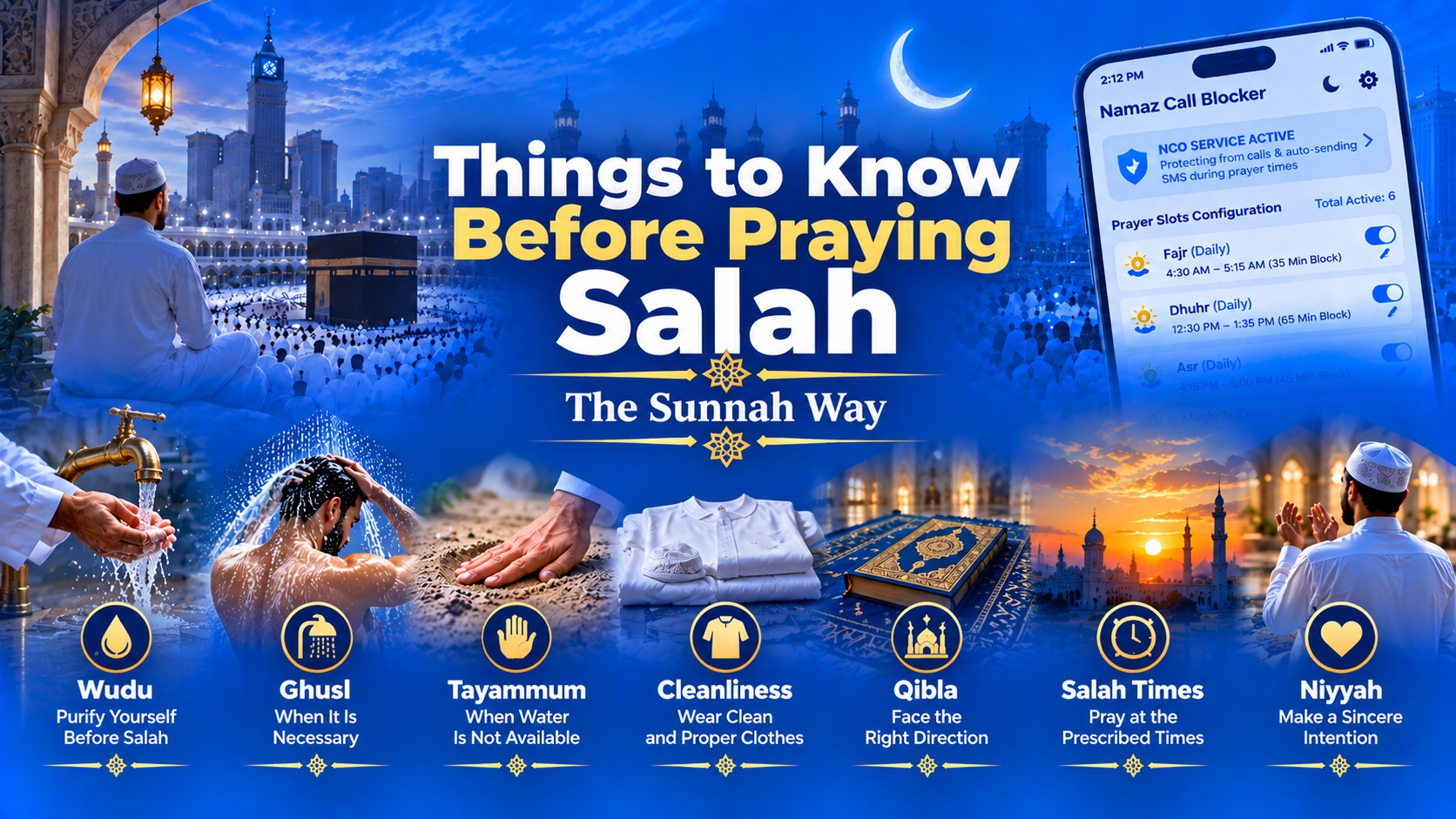
Salah is one of the Five Pillars of Islam and an essential part of a Muslim’s daily life. It is an act of worship through which Muslims remember Allah Subhanahu wa Ta’ala, express gratitude, seek forgiveness, and strengthen their connection with their Creator.
Before performing Salah, however, there are certain conditions that every Muslim should understand and fulfil. These include ritual purification, appropriate clothing, a clean place for prayer, facing the Qibla, and ensuring that the prescribed prayer time has begun.
These requirements are not simply preparations; they form an important part of performing Salah correctly according to Islamic teachings.
The Qur’an and the Sunnah of Prophet Muhammad (peace be upon him) provide guidance on how Muslims should prepare themselves for prayer.
In this article, Things to Know Before Praying Salah: The Sunnah Way, we will explore these essential requirements, explain their importance, and understand them through references from the Qur’an and authentic Hadith.
Whether you are learning Salah for the first time or looking to strengthen your understanding, this guide will help you prepare for prayer with greater knowledge, confidence, and sincerity.
Why Is Preparation Important Before Salah?
Salah is not simply a collection of physical movements. It is an act of worship that requires both outward preparation and inward intention.
Before a Muslim begins Salah, certain conditions must be fulfilled for the prayer to be valid. These include ritual purity, covering the required parts of the body, facing the Qibla, and praying within the prescribed time.
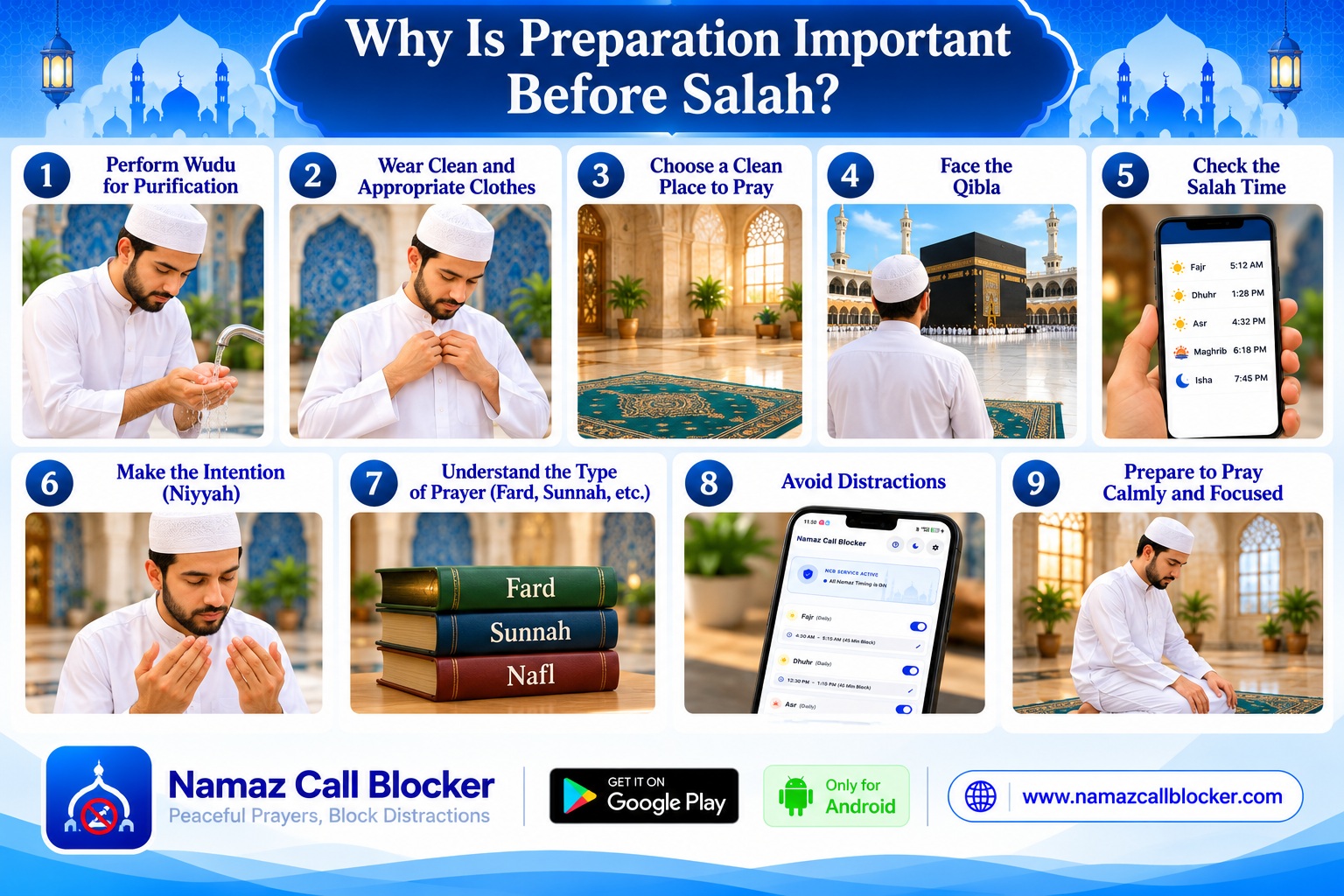
Other preparations, such as avoiding distractions and allowing enough time, help a person approach prayer with greater concentration.
Understanding the difference is important. Some requirements determine whether Salah is valid, while others help improve its quality.
If you are still learning about the purpose of Islamic prayer, read our related article: What Is Salah, Why Is It Important for Muslims?.
1. Perform the Required Purification Before Salah
Purification is one of the first things a Muslim should consider before praying.
Islam distinguishes between physical cleanliness and ritual purity. A person may have clean hands, clothes and surroundings but still need Wudu or Ghusl before performing Salah.
Allah Subhanahu wa Ta’ala explains the requirements of purification in the Qur’an.
Qur’an — Surah Al-Ma’idah (5:6), excerpt
يَا أَيُّهَا الَّذِينَ آمَنُوا إِذَا قُمْتُمْ إِلَى الصَّلَاةِ فَاغْسِلُوا وُجُوهَكُمْ وَأَيْدِيَكُمْ إِلَى الْمَرَافِقِ
English translation (Sahih International, excerpt):
“O you who have believed, when you rise to [perform] prayer, wash your faces and your forearms to the elbows”
Reference: Qur’an 5:6
The verse continues with instructions concerning wiping the head, washing the feet, major ritual purification and the allowance of Tayammum in specified circumstances.
The Prophet Muhammad (peace be upon him) also taught that purification is required for prayer.
Hadith reference: Sahih Muslim 224a
When Is Wudu Necessary?
Wudu is the ritual washing performed when a person needs purification from minor ritual impurity.
Its essential actions are established in the Qur’an, while the Sunnah provides further details about its performance.
Common situations that require renewing Wudu include using the toilet, passing wind and other circumstances recognized in Islamic law.
However, Wudu does not automatically expire when one Salah ends. If your Wudu remains valid, you may generally use it for another prayer.
For a detailed explanation, read What Is Wudu, Why Is It Necessary for Salah?.
When Is Ghusl Required?
Ghusl is a full ritual bath required in certain circumstances involving major ritual impurity.
These include sexual intercourse, ejaculation and purification after menstruation or postnatal bleeding has ended.
Ghusl is not required before every daily Salah.
When Ghusl is necessary, however, ordinary Wudu alone does not replace it.
Learn more in What Is Ghusl, When Is It Necessary Before Salah?.
What If Water Is Unavailable or Harmful?
Islam also provides an alternative method of purification called Tayammum.
It may be permitted when water is unavailable or when using it would cause genuine harm, subject to the applicable conditions.
Allah mentions this allowance in Surah Al-Ma’idah 5:6 and Surah An-Nisa 4:43.
Tayammum is not simply a convenient substitute for Wudu. It is a religious concession intended for qualifying circumstances.
Read What Is Tayammum, When Is It Allowed Before Salah? to understand its conditions and method.
2. Wear Clean and Appropriate Clothing
Clothing is another important consideration before Salah.
Islam requires worshippers to cover the prescribed parts of their bodies during prayer. These requirements are discussed in Islamic jurisprudence under the concept of Satr al-Awrah.
The details differ for men and women, and certain rulings vary among the recognized schools of Islamic law.
Allah says:
Qur’an — Surah Al-A’raf (7:31), excerpt
يَا بَنِي آدَمَ خُذُوا زِينَتَكُمْ عِندَ كُلِّ مَسْجِدٍ
English translation (Sahih International, excerpt):
“O children of Adam, take your adornment at every masjid”
Reference: Qur’an 7:31
Scholars discuss this verse in connection with appropriate dress and respect during worship.
A person does not need expensive clothes or special ceremonial garments to perform Salah.
What matters is that the clothing meets the religious requirements for covering the body and is free from impurities that affect prayer.
What Should Men Wear for Salah?
Men must cover the required area of the body, with the minimum generally discussed as the region between the navel and knees. Jurists differ on certain boundary details.
Clothing should also be appropriate for the movements of prayer.
For example, a shirt that exposes the lower back during Sujud may create a problem if the required area becomes uncovered.
What Should Women Wear for Salah?
Women must observe the prescribed covering for Salah.
The schools of Islamic law differ regarding some details, particularly the feet and other specific areas.
A woman should follow reliable guidance appropriate to her school of law.
The purpose is not to make prayer unnecessarily difficult, but to fulfil its established requirements correctly.
3. Make Sure the Place of Prayer Is Clean
A Muslim does not need to be inside a mosque to perform Salah.
Prayer may be performed at home, at work, while travelling or in another suitable location, provided the relevant Islamic conditions are met.
The Prophet Muhammad (peace be upon him) explained that the earth had been made a place of prayer for his community.
Hadith reference: Sahih al-Bukhari 335
This teaching demonstrates that Salah is not restricted to one particular building.
However, the place of prayer must be suitable and free from impurities that affect the validity of Salah.
Is a Prayer Mat Necessary?
No. A prayer mat is not an obligatory requirement.
It is commonly used because it provides a convenient and clean surface.
If the ground is suitable and free from relevant impurities, Salah may generally be performed without a prayer mat.
It is also important to distinguish ordinary dust from religious impurity. A surface does not automatically become unsuitable for Salah merely because it is dusty.
4. Face the Qibla Before Beginning Salah
The Qibla is the direction Muslims face during Salah.
For Muslims throughout the world, this direction is toward the Kaaba in Makkah.
Allah Subhanahu wa Ta’ala says:
Qur’an — Surah Al-Baqarah (2:144), excerpt
فَوَلِّ وَجْهَكَ شَطْرَ الْمَسْجِدِ الْحَرَامِ
English translation (Sahih International, excerpt):
“So turn your face toward al-Masjid al-Haram.”
Reference: Qur’an 2:144
Facing the Qibla is a condition of obligatory Salah under normal circumstances, although Islamic law recognizes certain exceptions.
How Can You Find the Qibla?
In a mosque, the Mihrab generally indicates the direction of prayer.
At home or while travelling, you may use a reliable Qibla compass, consult a local mosque or ask someone familiar with the direction.
If you genuinely cannot determine the Qibla, the schools of Islamic law explain what reasonable effort is required and how to proceed.
The important thing is to make a sincere and reasonable effort rather than simply choosing a direction without checking.
5. Check the Correct Salah Time
Every obligatory Salah has a prescribed time.
Allah says:
Qur’an — Surah An-Nisa (4:103), excerpt
إِنَّ الصَّلَاةَ كَانَتْ عَلَى الْمُؤْمِنِينَ كِتَابًا مَّوْقُوتًا
English translation (Sahih International, excerpt):
“Indeed, prayer has been decreed upon the believers a decree of specified times.”
Reference: Qur’an 4:103
Muslims perform five obligatory daily prayers.
| Salah | General prescribed time |
|---|---|
| Fajr | From true dawn until sunrise |
| Dhuhr | After the sun passes its highest point |
| Asr | During the afternoon, according to the applicable juristic calculation |
| Maghrib | Beginning at sunset |
| Isha | Beginning after the disappearance of the relevant evening twilight |
These are general descriptions, not a substitute for a reliable local timetable.
The Prophet Muhammad (peace be upon him) explained the prayer times in authentic narrations.
Hadith reference: Sahih Muslim 612a
Why Do Salah Timings Change?
Prayer times are connected to the position of the sun.
As the date and geographical location change, the times of Fajr, Dhuhr, Asr, Maghrib and Isha also change.
Different calculation methods may produce slightly different results, particularly for Fajr, Asr and Isha.
For this reason, Muslims should consult a reliable local prayer timetable and follow the appropriate guidance for their community.
Beginning an obligatory Salah before its prescribed time is not valid under normal circumstances.
6. Make the Intention for Salah
Before praying, a Muslim should know which Salah they intend to perform.
This is called Niyyah, or intention.
For example, someone preparing for Fajr should know that they intend to perform the obligatory Fajr prayer.
The Prophet Muhammad (peace be upon him) taught:
“The reward of deeds depends upon the intentions”
Reference: Sahih al-Bukhari 1
The intention for Salah is fundamentally made in the heart.
There is no requirement to recite a particular Arabic formula aloud before every prayer.
Although the schools of Islamic law discuss certain details differently, the essential principle is that a person knows what they are praying and intends the act of worship for Allah.
Intention should not become a source of unnecessary anxiety.
If you know that you are standing to perform the obligatory Dhuhr prayer, for example, that awareness is central to the intention.
7. Understand the Difference Between Fard, Wajib and Sunnah Prayers
Before Salah, it is useful to know what type of prayer you are about to perform.
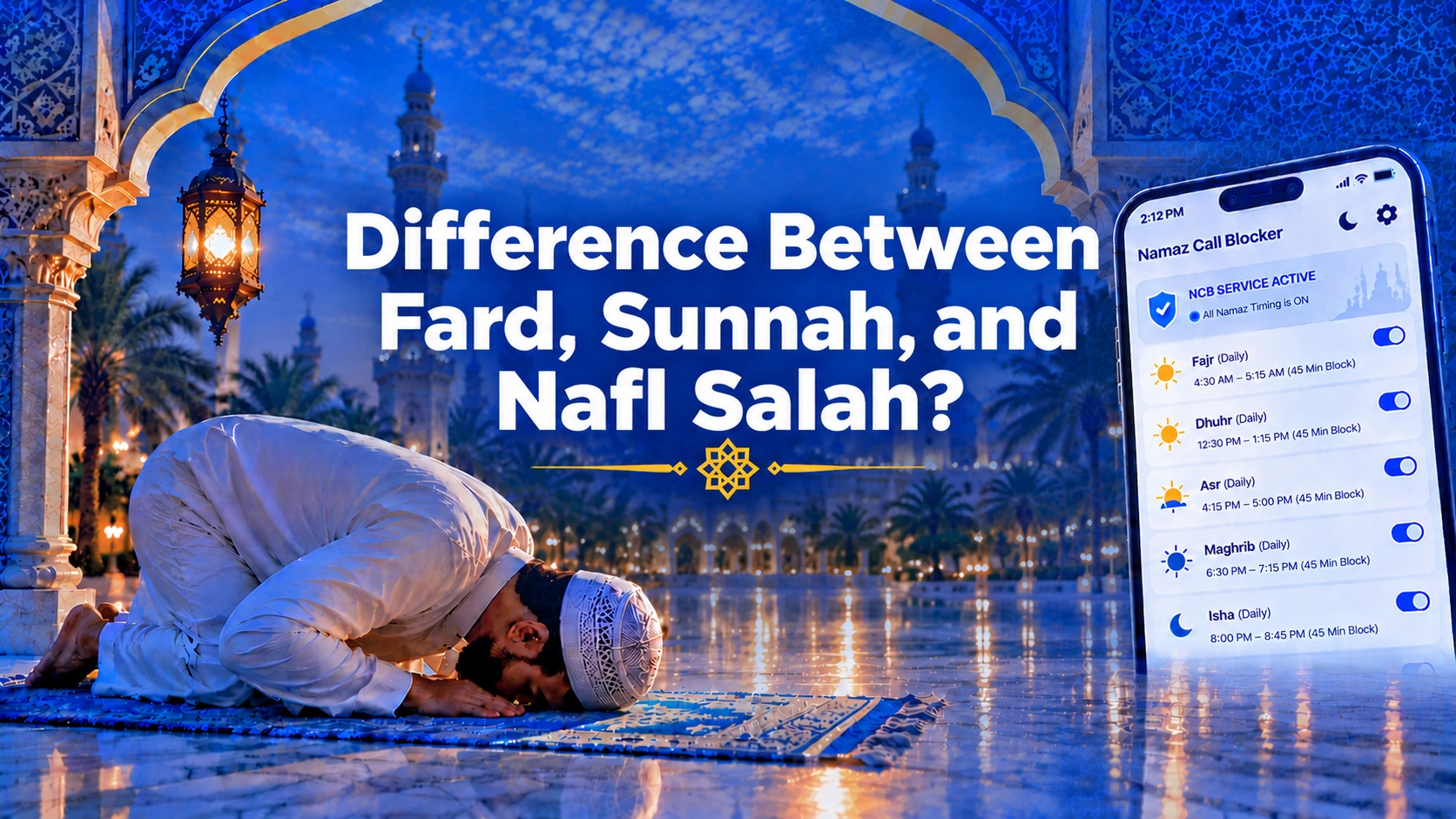
Muslims encounter terms such as Fard, Wajib, Sunnah and Nafl.
These terms describe different legal classifications of worship.
Fard refers to an obligatory act or prayer.
Wajib is a legal classification used distinctly from Fard in the Hanafi school, while other Sunni schools generally use the terminology differently.
Sunnah prayers are prayers established through the practice and teachings of Prophet Muhammad (peace be upon him). Their precise classifications vary according to the school of law.
Nafl generally refers to voluntary prayers.
For beginners, the first priority is understanding the five daily obligatory prayers and their Rak’ahs.
| Obligatory Salah | Fard Rak’ahs |
|---|---|
| Fajr | 2 |
| Dhuhr | 4 |
| Asr | 4 |
| Maghrib | 3 |
| Isha | 4 |
Additional Sunnah and voluntary prayers are performed around some of these obligatory prayers.
Understanding these distinctions helps a Muslim know which prayer they are performing and avoid confusing obligatory and voluntary worship.
8. Know Whether You Are Praying Alone or Behind an Imam
Salah may be performed individually or in congregation, depending on the prayer and circumstances.
Congregational Salah has a significant place in Islam.
When praying behind an Imam, worshippers follow the Imam rather than moving independently.
The Prophet Muhammad (peace be upon him) instructed Muslims to follow the Imam during congregational prayer.
Hadith reference: Sahih al-Bukhari 722
There are differences among the recognized Sunni schools concerning certain recitations and other details when praying behind an Imam.
If you are learning congregational Salah for the first time, ask a knowledgeable local teacher to explain the method followed in your community.
For obligatory prayers, the rulings and emphasis concerning congregation may differ according to the person, prayer and school of Islamic law.
9. Avoid Distractions Before Salah
Preparing for Salah also involves considering the environment around you.
Many people pray at home, in offices or in other places where interruptions are possible.
A ringing phone, conversation or unexpected notification may disturb concentration.
Although silencing a phone is not a condition for the validity of Salah, reducing avoidable distractions can help a person focus.
Before beginning, consider putting your phone on silent, choosing a suitable place and allowing enough time for prayer.
How Can Technology Help Reduce Phone Distractions?

Modern smartphones provide several ways to manage interruptions.
For Android users, Salah App – Namaz Call Blocker offers features designed to reduce incoming-call disturbances during configured Salah times.
Depending on the permissions granted and the settings selected, the app can automatically reject incoming calls, send optional SMS replies, switch the phone to silent or vibrate mode and restore its previous sound settings afterward.
The app is free to use, supports offline core functionality and does not display ads.
Only for Android.
Technology cannot replace sincerity or concentration in worship, but it can help remove some practical distractions.
10. Prepare to Perform Salah Calmly
Salah should not be treated as a task to finish as quickly as possible.
The Prophet Muhammad (peace be upon him) emphasized calmness and proper completion of the prayer’s movements.
In an authentic narration, he instructed a man to repeat his prayer and explained the importance of becoming settled during its positions.
Hadith reference: Sahih al-Bukhari 757
This teaching concerns the actual performance of Salah, but it also offers a useful lesson for preparation.
If possible, avoid delaying prayer until you feel forced to rush.
Complete your purification, check the prayer time and give yourself enough time to pray attentively.
This does not mean every prayer must be unusually long. Rather, it means performing Salah with the calmness required by its teachings.
Essential Checklist Before Praying Salah
The following table summarizes the main points discussed in this guide.
| Preparation | What you should check |
|---|---|
| Ritual purity | Do I have valid Wudu, Ghusl or Tayammum as required? |
| Clothing | Am I covering the required parts of my body? |
| Cleanliness | Are my body, clothing and prayer place free from relevant impurities? |
| Qibla | Am I facing the correct direction? |
| Prayer time | Has the prescribed time begun? |
| Intention | Do I know which Salah I am performing? |
| Prayer type | Is this Fard, Wajib, Sunnah or Nafl? |
| Congregation | Am I praying alone or following an Imam? |
| Distractions | Have I reduced avoidable interruptions? |
| Time and attention | Am I prepared to pray without unnecessary rushing? |
Not every item has the same legal status.
Purification, appropriate covering, cleanliness, Qibla, prayer time and intention are among the essential conditions under normal circumstances. Other preparations help organize worship and improve concentration.
Frequently Asked Questions About Preparing for Salah
1. Is Wudu required before every Salah?
No. If your previous Wudu remains valid, you generally do not need to perform it again before each prayer.
2. Can I perform Salah without a prayer mat?
Yes. A prayer mat is not obligatory. You may pray on a suitable surface that meets the relevant cleanliness requirements.
3. Is Ghusl necessary before every prayer?
No. Ghusl is required only in particular circumstances involving major ritual impurity.
4. Can I pray if water is unavailable?
Tayammum may be permitted when its conditions are met, such as when water is genuinely unavailable or its use would cause harm.
5. What should I do if I do not know the Qibla?
Make a reasonable effort to determine the direction using reliable information. If you cannot establish it, follow qualified scholarly guidance for your situation.
6. Is it necessary to say the intention aloud?
No particular spoken intention formula is required. Niyyah is fundamentally an intention of the heart.
7. Can I pray in my everyday clothes?
Yes, provided they meet the requirements for covering the body and are free from impurities that affect Salah.
8. Can I perform Salah at home?
Yes, Salah may be performed at home. However, the rulings concerning congregational prayer differ according to the prayer, individual circumstances and school of law.
9. Is turning off my phone necessary before Salah?
No. Turning off or silencing your phone is not a religious condition for Salah. It is a practical measure that may help prevent distractions.
10. What should I learn after understanding these preparations?
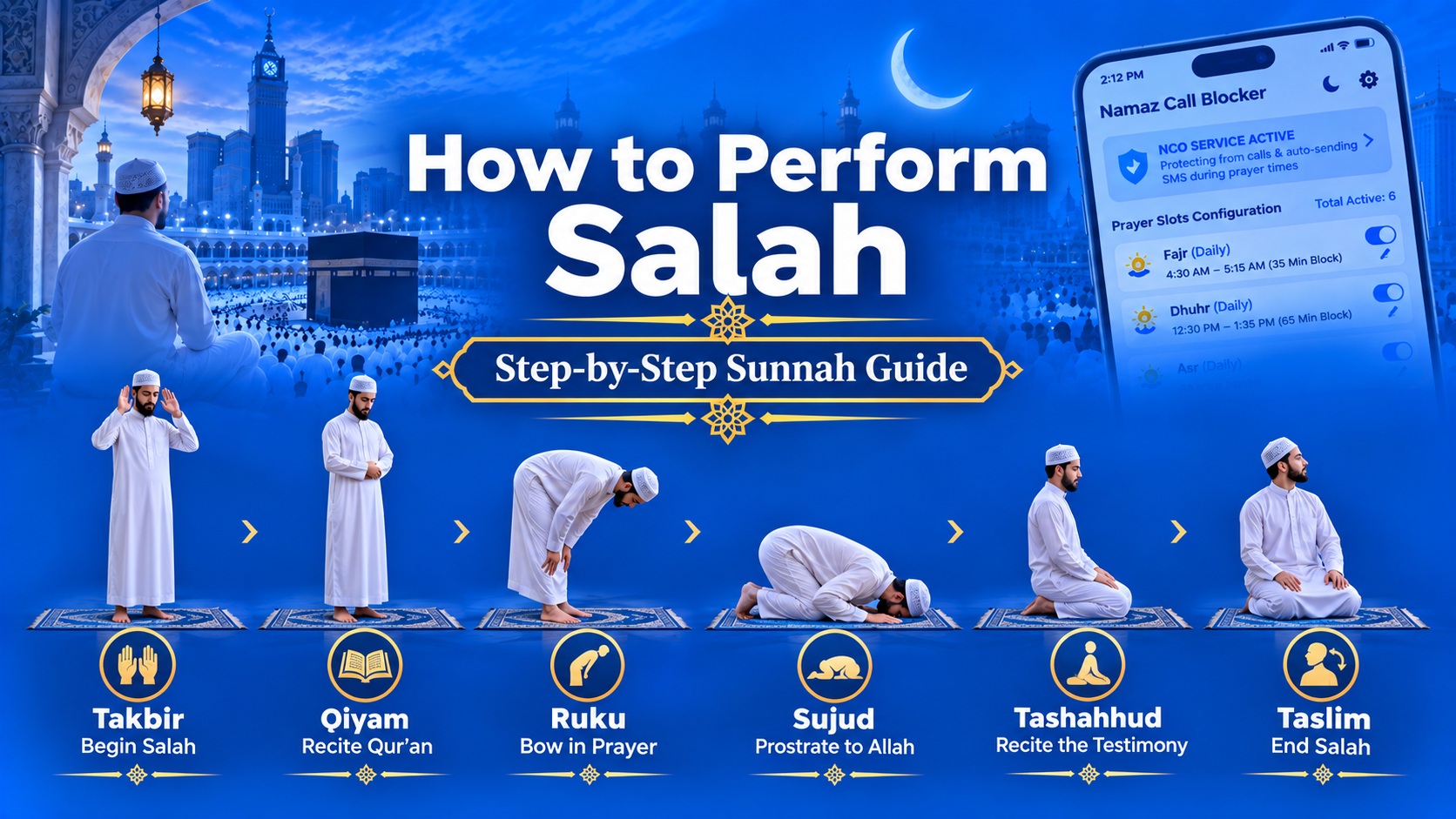
The next step is learning the practical method of Salah, including Takbir, standing, recitation, Ruku, Sujud, Tashahhud and Taslim.
These subjects are covered in our separate guide, How to Perform Salah: Step-by-Step Sunnah Guide.
Conclusion
Preparing for Salah is an important part of understanding Islamic prayer.
The Qur’an and the Sunnah guide Muslims in matters of purification, clothing, cleanliness, Qibla, prayer times and intention.
These requirements help ensure that Salah is performed correctly, while practical preparations such as reducing distractions and avoiding unnecessary rushing can help improve concentration.
Whether you have been praying for many years or are still learning, understanding these principles can make your daily worship more informed and consistent.
The aim is not to make preparation complicated, but to recognize what Islam requires and approach Salah with sincerity and care.
Once these foundations are understood, the next step is learning how to perform the prayer itself according to the Sunnah of Prophet Muhammad (peace be upon him).
Qur’an and Authentic Hadith References
| Source | Topic |
|---|---|
| Surah Al-Ma’idah 5:6 | Wudu, Ghusl and Tayammum |
| Surah An-Nisa 4:43 | Ritual purification and Tayammum |
| Surah Al-A’raf 7:31 | Appropriate clothing for worship |
| Surah Al-Baqarah 2:144 | Facing the Qibla |
| Surah An-Nisa 4:103 | Prescribed prayer times |
| Sahih Muslim 224a | Purification and prayer |
| Sahih Muslim 612a | Times of the daily prayers |
| Sahih al-Bukhari 1 | Intention |
| Sahih al-Bukhari 335 | The earth as a place of prayer |
| Sahih al-Bukhari 722 | Following the Imam |
| Sahih al-Bukhari 757 | Calmness during Salah |
Educational note: This article explains general Sunni Islamic teachings. Certain details differ among the Hanafi, Shafi’i, Maliki and Hanbali schools. For individual circumstances or questions affecting prayer validity, consult a qualified Islamic scholar.