How to Perform Salah: Step-by-Step Sunnah Guide
Mohd Danish
Founder & Developer
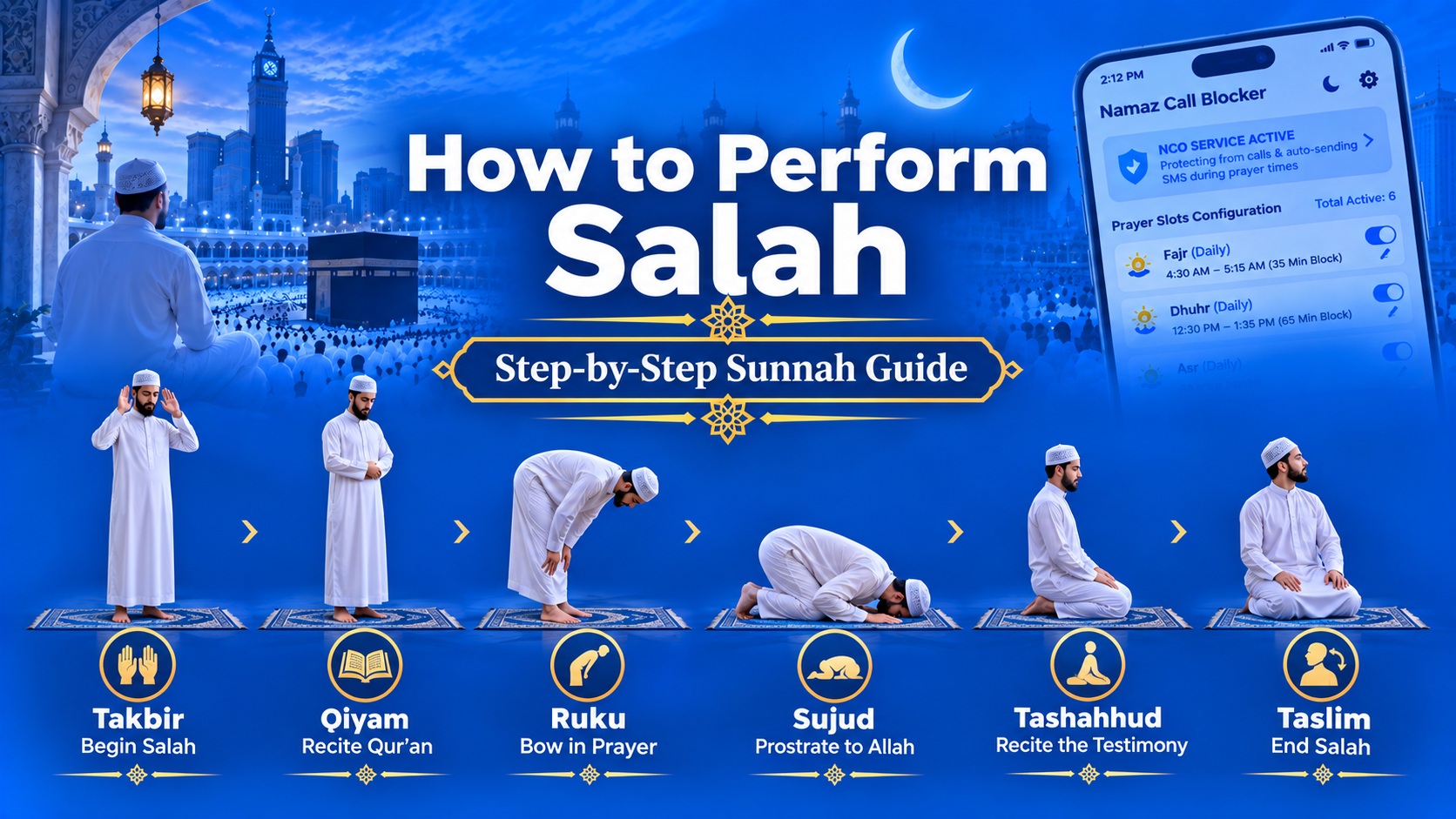
Salah is one of the Five Pillars of Islam and an essential act of worship in a Muslim’s daily life. Through Salah, Muslims remember Allah Subhanahu wa Ta’ala, express gratitude, seek forgiveness and strengthen their connection with their Creator.
For someone who has learned Salah since childhood, its movements may feel familiar. However, for a new Muslim or someone learning to pray correctly, remembering the sequence of movements and recitations can take time.
Where should you place your hands? What should you recite while standing? How many times should you perform Sujud? What happens after the second Rak’ah?
This guide explains the basic method of performing Salah, from the opening Takbir to the concluding Taslim, with references to the Qur’an and authentic Hadith.
Prophet Muhammad (peace be upon him) instructed Muslims:
“Pray as you have seen me praying.”
Reference: Sahih al-Bukhari 631
If you are new to Islamic prayer, begin with our introductory article, What Is Salah, Why Is It Important for Muslims?, which explains its meaning, importance and place in Islam.
What Should You Know Before Performing Salah?
Before beginning Salah, Muslims must fulfil certain requirements relating to purification, cleanliness, prayer time, direction and intention.
These preparations include:
- Performing Wudu or another required form of purification.
- Wearing clean and appropriate clothing.
- Choosing a suitable place for prayer.
- Facing the Qibla.
- Ensuring the correct Salah time has begun.
- Making the intention to pray.
Allah says:
Arabic — excerpt from Surah An-Nisa (4:103):
إِنَّ الصَّلَاةَ كَانَتْ عَلَى الْمُؤْمِنِينَ كِتَابًا مَّوْقُوتًا
English translation — Dr. Mustafa Khattab, The Clear Quran:
“Indeed, performing prayers is a duty on the believers at the appointed times.”
Reference: Qur’an 4:103
For a detailed explanation, read Things to Know Before Praying Salah: The Sunnah Way.
Understanding Wudu, Ghusl and Tayammum
Purification is an important condition before Salah.
Wudu is the ritual washing performed before prayer when required. Learn its method and importance in What Is Wudu, Why Is It Important for Salah/Namaz?.
Ghusl is a full ritual bath required in certain circumstances involving major ritual impurity. Learn more in What Is Ghusl, When Is It Necessary Before Salah?.
Tayammum is a prescribed form of dry purification permitted when its conditions are fulfilled, such as when water is unavailable or its use would cause harm. Read What Is Tayammum, When Is It Allowed Before Salah?.
Once the relevant conditions have been fulfilled, you can begin Salah.
How Many Rak’ahs Are in the Five Daily Salah?
A Rak’ah is one unit of Salah containing standing, recitation, bowing and prostration.
The five daily obligatory prayers contain the following Fard Rak’ahs:
| Salah | Fard Rak’ahs |
|---|---|
| Fajr | 2 |
| Dhuhr | 4 |
| Asr | 4 |
| Maghrib | 3 |
| Isha | 4 |
These numbers refer to the obligatory units only. Additional Sunnah and voluntary prayers are associated with the daily prayers.
For beginners, learning a two-Rak’ah prayer is a useful starting point.
How to Perform Salah Step by Step
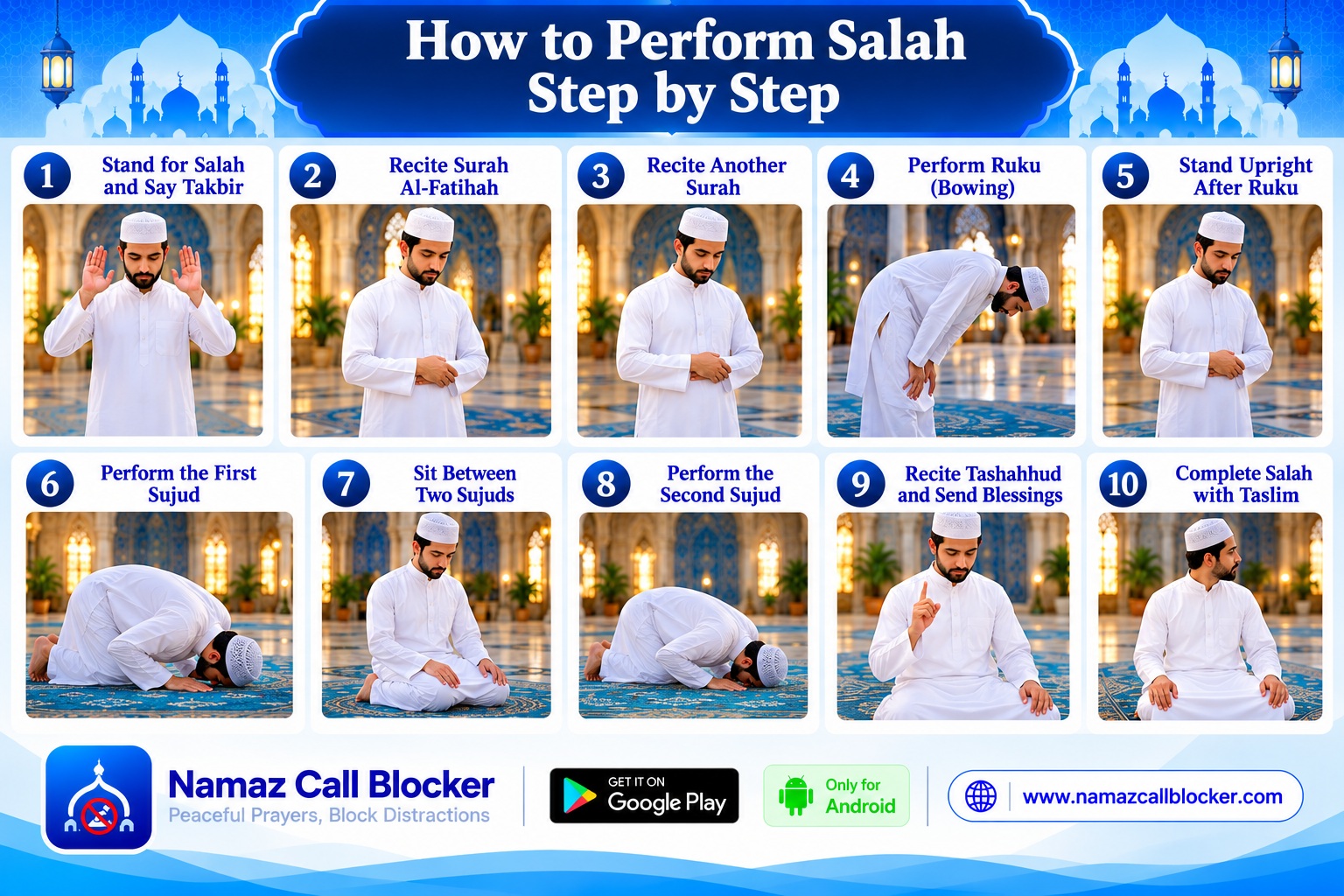
The following explanation uses a two-Rak’ah prayer as an example.
Step 1: Stand Facing the Qibla and Begin With Takbir
Stand facing the Qibla with the intention of performing the appropriate Salah.
Raise your hands according to the prayer method you follow and say:
Arabic:
اللَّهُ أَكْبَرُ
Transliteration: Allahu Akbar
Meaning: Allah is the Greatest.
This opening declaration is known as Takbirat al-Ihram and marks the beginning of Salah.
After Takbir, place your hands according to your school of Islamic law. Recognized Sunni schools differ regarding their precise placement.
Step 2: Recite Surah Al-Fatihah
While standing, recite Surah Al-Fatihah, the opening chapter of the Qur’an.
Arabic:
بِسْمِ اللَّهِ الرَّحْمَٰنِ الرَّحِيمِ
الْحَمْدُ لِلَّهِ رَبِّ الْعَالَمِينَ
الرَّحْمَٰنِ الرَّحِيمِ
مَالِكِ يَوْمِ الدِّينِ
إِيَّاكَ نَعْبُدُ وَإِيَّاكَ نَسْتَعِينُ
اهْدِنَا الصِّرَاطَ الْمُسْتَقِيمَ
صِرَاطَ الَّذِينَ أَنْعَمْتَ عَلَيْهِمْ غَيْرِ الْمَغْضُوبِ عَلَيْهِمْ وَلَا الضَّالِّينَ
Reference: Surah Al-Fatihah — Qur’an 1:1–7
Surah Al-Fatihah expresses praise of Allah, devotion to Him and a request for guidance.
The Prophet Muhammad (peace be upon him) emphasized its importance in prayer.
Hadith reference: Sahih al-Bukhari 756
The rulings concerning recitation behind an Imam differ among Sunni schools.
Step 3: Recite Another Passage From the Qur’an
After Al-Fatihah, recite another Surah or passage from the Qur’an as appropriate.
For example, Surah Al-Ikhlas:
Arabic:
قُلْ هُوَ اللَّهُ أَحَدٌ
اللَّهُ الصَّمَدُ
لَمْ يَلِدْ وَلَمْ يُولَدْ
وَلَمْ يَكُنْ لَهُ كُفُوًا أَحَدٌ
Reference: Surah Al-Ikhlas — Qur’an 112
This Surah teaches the oneness and uniqueness of Allah.
Beginners can gradually learn shorter Surahs while improving their Arabic recitation.
The legal requirements concerning additional Qur’anic recitation differ according to the school of Islamic law and the Rak’ah being performed.
Step 4: Perform Ruku — Bowing
After recitation, say Allahu Akbar and bow.
This position is called Ruku.
Keep your back reasonably level and place your hands on your knees according to the established method.
A commonly recited remembrance is:
Arabic:
سُبْحَانَ رَبِّيَ الْعَظِيمِ
Transliteration: Subhana Rabbiyal-Azeem
Meaning: Glory be to my Lord, the Magnificent.
It is commonly recited three times, although the rulings concerning repetition differ among scholars.
The Prophet Muhammad (peace be upon him) emphasized remaining settled during bowing.
Reference: Sahih al-Bukhari 757
Step 5: Rise From Ruku
Rise until you are standing upright.
When rising, the person praying individually or leading the prayer says:
Arabic:
سَمِعَ اللَّهُ لِمَنْ حَمِدَهُ
Transliteration: Sami’ Allahu liman hamidah
Meaning: Allah hears the one who praises Him.
While standing, say:
Arabic:
رَبَّنَا وَلَكَ الْحَمْدُ
Transliteration: Rabbana wa lakal-hamd
Meaning: Our Lord, to You belongs all praise.
The precise recitations for someone following an Imam differ among schools.
Remain upright and settled before moving into Sujud.
Step 6: Perform the First Sujud — Prostration
Say Allahu Akbar and move into prostration.
During Sujud, the forehead and nose, both hands, both knees and the toes of both feet are placed in the prescribed manner.
The Prophet Muhammad (peace be upon him) described prostrating on seven bodily parts.
Reference: Sahih Muslim 490e
A commonly recited remembrance is:
Arabic:
سُبْحَانَ رَبِّيَ الْأَعْلَى
Transliteration: Subhana Rabbiyal-A’la
Meaning: Glory be to my Lord, the Most High.
It is commonly recited three times.
Sujud is also an important position for supplication, subject to the applicable rules of Salah.
Step 7: Sit Between the Two Prostrations
After the first Sujud, say Allahu Akbar and sit upright.
Remain settled before performing the second prostration.
One reported supplication for this position is:
Arabic:
رَبِّ اغْفِرْ لِي
Transliteration: Rabbighfir li
Meaning: My Lord, forgive me.
Other authentic supplications and variations in sitting posture are also reported.
Step 8: Perform the Second Sujud
Say Allahu Akbar and perform Sujud again.
Recite the appropriate remembrance and remain settled.
After the second Sujud, the first Rak’ah is complete.
The basic sequence of one Rak’ah is:
Standing → Recitation → Ruku → Standing upright → First Sujud → Sitting → Second Sujud
Step 9: Stand for the Second Rak’ah
Rise for the second Rak’ah.
Recite Surah Al-Fatihah and another appropriate Qur’anic passage.
Then perform:
- Ruku.
- Standing upright after Ruku.
- First Sujud.
- Sitting between the prostrations.
- Second Sujud.
After completing the second Rak’ah, sit for Tashahhud.
Step 10: Recite Tashahhud
Tashahhud is recited while sitting during Salah.
One authentic wording is:
Arabic:
التَّحِيَّاتُ لِلَّهِ وَالصَّلَوَاتُ وَالطَّيِّبَاتُ، السَّلَامُ عَلَيْكَ أَيُّهَا النَّبِيُّ وَرَحْمَةُ اللَّهِ وَبَرَكَاتُهُ، السَّلَامُ عَلَيْنَا وَعَلَى عِبَادِ اللَّهِ الصَّالِحِينَ، أَشْهَدُ أَنْ لَا إِلَهَ إِلَّا اللَّهُ، وَأَشْهَدُ أَنَّ مُحَمَّدًا عَبْدُهُ وَرَسُولُهُ
Transliteration:
At-tahiyyatu lillahi was-salawatu wat-tayyibat. As-salamu ‘alayka ayyuhan-nabiyyu wa rahmatullahi wa barakatuh. As-salamu ‘alayna wa ‘ala ‘ibadillahis-salihin. Ashhadu an la ilaha illallah, wa ashhadu anna Muhammadan ‘abduhu wa rasuluh.
Meaning — explanatory rendering:
All greetings, prayers and good words belong to Allah. Peace, Allah’s mercy and blessings be upon the Prophet. Peace be upon us and Allah’s righteous servants. I testify that none is worthy of worship except Allah, and that Muhammad is His servant and Messenger.
Reference: Sahih al-Bukhari 831
Other authentic forms of Tashahhud also exist.
Step 11: Send Blessings Upon Prophet Muhammad
During the final sitting, Muslims recite blessings upon Prophet Muhammad (peace be upon him).
One authentic form of Salat Ibrahimiyyah is:
Arabic:
اللَّهُمَّ صَلِّ عَلَى مُحَمَّدٍ وَعَلَى آلِ مُحَمَّدٍ كَمَا صَلَّيْتَ عَلَى آلِ إِبْرَاهِيمَ إِنَّكَ حَمِيدٌ مَجِيدٌ
اللَّهُمَّ بَارِكْ عَلَى مُحَمَّدٍ وَعَلَى آلِ مُحَمَّدٍ كَمَا بَارَكْتَ عَلَى آلِ إِبْرَاهِيمَ إِنَّكَ حَمِيدٌ مَجِيدٌ
Meaning — explanatory rendering:
O Allah, send Your blessings upon Muhammad and the family of Muhammad as You sent blessings upon the family of Ibrahim. You are Praiseworthy and Glorious.
O Allah, bless Muhammad and the family of Muhammad as You blessed the family of Ibrahim. You are Praiseworthy and Glorious.
Reference: Sahih al-Bukhari 3370
Other authentic versions include additional wording mentioning Ibrahim directly.
An appropriate supplication may also be made before concluding Salah.
Step 12: Complete Salah With Taslim
To conclude the prayer, turn your head to the right and say:
Arabic:
السَّلَامُ عَلَيْكُمْ وَرَحْمَةُ اللَّهِ
Transliteration: As-salamu ‘alaykum wa rahmatullah
Meaning: Peace and the mercy of Allah be upon you.
Then turn to the left and repeat the greeting according to the method followed.
This concluding greeting is called Taslim.
The two-Rak’ah Salah is now complete.
How Do You Perform Three or Four Rak’ahs?
The fundamental movements remain the same, but the number of Rak’ahs changes.
For a three-Rak’ah obligatory prayer, such as Maghrib, complete two Rak’ahs and sit for the first Tashahhud. Then stand for the third Rak’ah.
After completing the third Rak’ah, sit for the final Tashahhud, recite the prescribed blessings and conclude with Taslim.
For a four-Rak’ah obligatory prayer, such as Dhuhr, Asr or Isha, stand after the first sitting and complete the third and fourth Rak’ahs before the final sitting.
In the third and fourth Rak’ahs of obligatory prayers, additional Qur’anic recitation after Al-Fatihah is generally omitted, subject to the applicable juristic rulings.
Beginners should first become comfortable with the two-Rak’ah sequence before learning how to connect additional Rak’ahs.
Why Is Calmness Important During Salah?
An important lesson about Salah comes from a man who prayed in the presence of Prophet Muhammad (peace be upon him).
After observing his prayer, the Prophet instructed him to repeat it.
When the man asked to be taught, the Prophet explained the importance of becoming settled while bowing, standing, prostrating and sitting.
Reference: Sahih al-Bukhari 757
This Hadith teaches that Salah is not simply about reaching each position.
The movements must be performed with the calmness and completeness required by Islamic teachings.
Avoid rushing through Ruku and Sujud without becoming settled.
Do All Muslims Perform Salah in Exactly the Same Way?
Muslims share the essential structure of Salah, including Takbir, standing, Qur’anic recitation, Ruku, Sujud and the concluding stages of prayer.
However, certain details differ among the Hanafi, Shafi’i, Maliki and Hanbali schools.
These differences may concern hand placement, raising the hands at particular points, recitation behind an Imam, the movement of the index finger during Tashahhud and some sitting postures.
The schools also differ in the legal classification of certain actions.
A beginner should learn a coherent method from a knowledgeable teacher rather than combining isolated rulings without understanding their context.
Common Mistakes Beginners Should Avoid
Rushing through Salah: Become settled during Ruku, standing upright, Sujud and sitting.
Forgetting the sequence: Learn one Rak’ah carefully before trying to memorize every additional recitation.
Depending entirely on transliteration: Transliteration can help beginners, but listening to a qualified Arabic reciter or teacher is important for improving pronunciation.
Confusing Fard and Sunnah Rak’ahs: Learn the obligatory units of each daily prayer before adding other prayers.
Becoming anxious about minor differences: Some variations in posture and recitation are recognized differences of Islamic jurisprudence.
Allowing avoidable distractions: Prepare your surroundings and manage phone interruptions before starting.
If a mistake occurs during Salah, the appropriate ruling depends on the nature of the mistake and the school of law followed. Some situations involve Sujud as-Sahw (prostration of forgetfulness).
How Can You Improve Concentration During Salah?

Concentration in Salah is often discussed through the concept of Khushu’—humble attentiveness and reverence before Allah.
Understanding the meanings of Al-Fatihah, Tashahhud and the common remembrances can help a person become more conscious of what they are reciting.
Preparing before the prayer time and reducing avoidable interruptions may also help.
For Android users, Namaz Call Blocker provides optional features that help manage incoming calls and phone sound settings during configured Salah times.
The app is a practical tool for reducing interruptions; it does not replace the inward effort required for concentration in worship.
For more preparation tips, revisit Things to Know Before Praying Salah: The Sunnah Way.
Frequently Asked Questions About Performing Salah
1. Can a beginner learn Salah step by step?
Yes. A beginner can start with the essential movements and recitations of a two-Rak’ah prayer and gradually learn additional details with guidance from a qualified teacher.
2. Do I have to recite Salah in Arabic?
The prescribed Qur’anic recitations and prayer formulas are ordinarily performed in Arabic. Rulings for someone genuinely unable to recite them yet differ among scholars, so a new learner should seek qualified guidance.
3. Is Surah Al-Fatihah necessary in Salah?
Al-Fatihah has an essential role in Salah, as established in authentic Hadith. The rulings for someone following an Imam differ among Sunni schools.
4. What is the difference between Salah and Rak’ah?
Salah refers to the ritual prayer. A Rak’ah is one unit within that prayer.
5. How many Sujud are performed in one Rak’ah?
Each Rak’ah contains two prostrations, with a sitting position between them.
6. Can I perform Salah while sitting?
A person genuinely unable to stand may pray sitting, subject to the applicable rules. Standing is ordinarily required for obligatory Salah when the person is able.
7. What happens if I forget something during Salah?
The ruling depends on what was forgotten. Some mistakes may be addressed through Sujud as-Sahw, while others may affect the validity of the prayer.
8. Is every detail of Salah performed identically in all four Sunni schools?
No. The fundamental structure is shared, but certain movements, recitations and legal classifications differ.
Explore Our Complete Salah Learning Series
Learning Salah becomes easier when each subject is studied in a logical order. Our educational series explains the importance of prayer, its preparation, purification requirements and practical method.
| Article | What You Will Learn |
|---|---|
| Five Pillars of Islam | Why Salah is one of the five foundational pillars of Islam |
| What Is Salah, Why Is It Important for Muslims? | The meaning, purpose and importance of the five daily prayers |
| What Is Wudu, Why Is It Important for Salah/Namaz? | Ritual washing and preparation for prayer |
| What Is Ghusl, When Is It Necessary Before Salah? | When a full ritual bath is required |
| What Is Tayammum, When Is It Allowed Before Salah? | Dry purification and its conditions |
| Things to Know Before Praying Salah: The Sunnah Way | Essential preparations before beginning Salah |
| How to Perform Salah: Step-by-Step Sunnah Guide | The practical movements and recitations of Salah |
Each article focuses on a different subject, helping beginners develop their understanding without unnecessary repetition.
Conclusion
Learning Salah takes knowledge, practice and patience.
The Prophet Muhammad (peace be upon him) taught Muslims how to pray through both his instructions and his example.
Understanding the sequence—from Takbir and Qur’anic recitation to Ruku, Sujud, Tashahhud and Taslim—provides a foundation for performing Salah correctly.
For beginners, the aim should be to learn the essentials carefully, improve Arabic recitation over time and develop greater attentiveness during prayer.
If you are just beginning your learning journey, explore our Salah preparation guide and other related articles to understand both the requirements and the method of prayer.
Qur’an and Authentic Hadith References
| Source | Subject |
|---|---|
| Qur’an 4:103 | Prescribed times of Salah |
| Surah Al-Fatihah | Recitation in Salah |
| Surah Al-Ikhlas | Example of Qur’anic recitation |
| Sahih al-Bukhari 631 | Following the Prophet’s prayer |
| Sahih al-Bukhari 756 | Importance of Al-Fatihah |
| Sahih al-Bukhari 757 | Calmness and proper movements |
| Sahih al-Bukhari 831 | Tashahhud |
| Sahih al-Bukhari 3370 | Blessings upon the Prophet |
| Sahih Muslim 490e | Bodily parts used in Sujud |
Educational note: This article describes a general Sunni method of Salah. Certain details and rulings differ among recognized schools of Islamic jurisprudence. For practical instruction and individual questions, consult a qualified teacher or scholar.