Faith in Islam: The Six Articles of Faith Explained
Mohd Danish
Founder & Developer
Arkan-e-Iman — Understanding Faith, Human Intelligence, and the Purpose of Life
Introduction: We Have Learned So Much, Yet So Many Questions Remain
Humanity has achieved things that once seemed impossible.
We have developed artificial intelligence, explored distant planets, studied DNA, and created computers capable of processing enormous amounts of information.
Yet, despite these achievements, some questions remain deeply personal:
Why do we exist? Who created us? What is the purpose of life? And what happens after death?
Science helps us understand how the physical world works. Islam invites us to reflect on the deeper questions of existence, responsibility, and our relationship with the Creator.
At the heart of Islamic belief are the Six Articles of Faith, also known as Arkan-e-Iman.
Whether you are Muslim or exploring Islam for the first time, these beliefs offer an opportunity to understand the Islamic perspective on life and its purpose.
What Are the Six Articles of Faith in Islam?
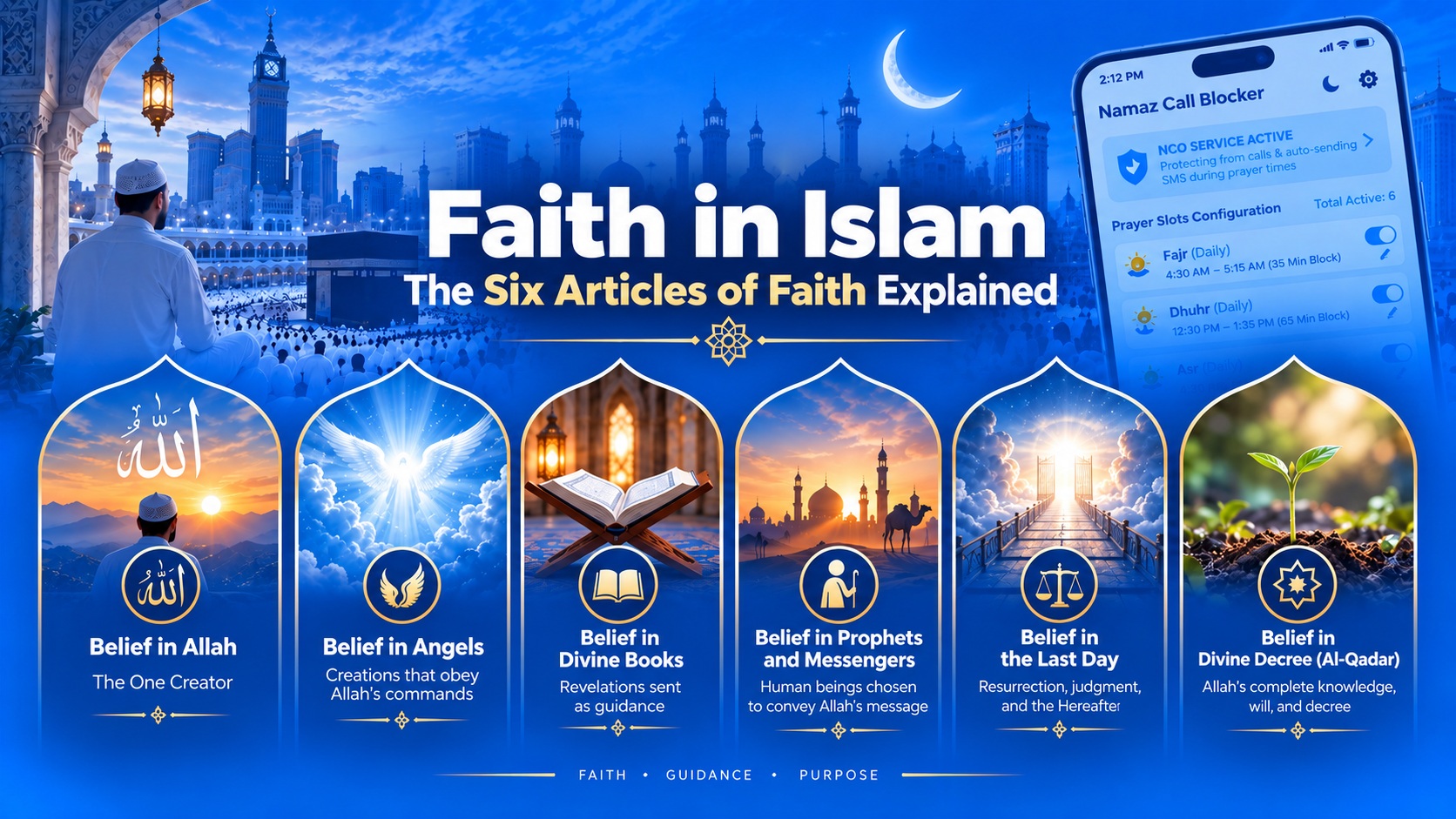
The Six Articles of Faith in Islam (Arkan-e-Iman) are the six essential beliefs that form the foundation of Iman, meaning faith.
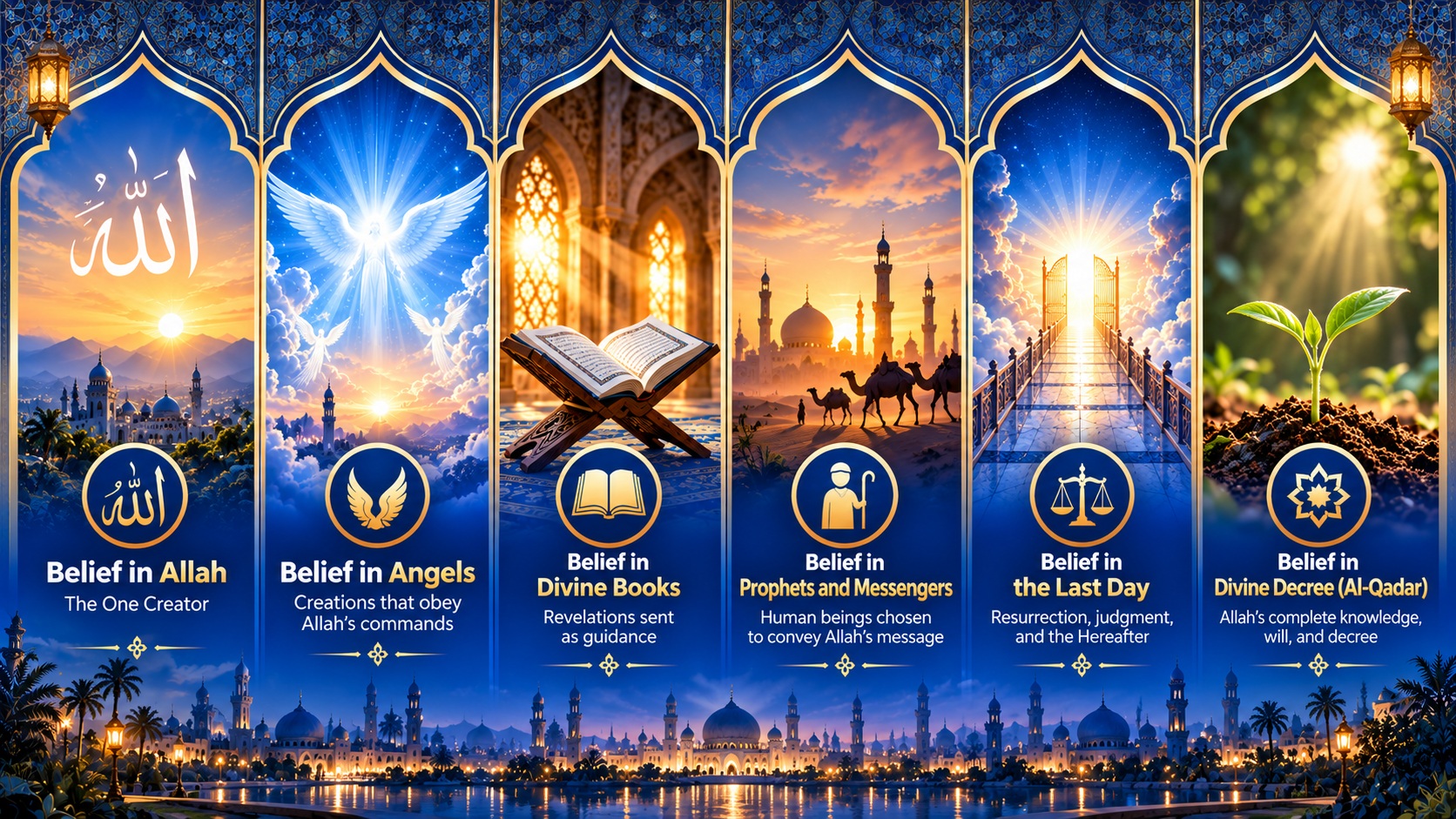
They are:
- Belief in Allah — The One Creator.
- Belief in Angels — Creations that obey Allah’s commands.
- Belief in Divine Books — Revelations sent by Allah.
- Belief in Prophets and Messengers — Those chosen to convey Allah’s guidance.
- Belief in the Last Day — Resurrection, judgment, and the Hereafter.
- Belief in Divine Decree (Al-Qadar) — Allah’s complete knowledge, will, and decree.
These beliefs are explained together in the famous Hadith of Jibril.
Authentic reference: Sahih Muslim 8a
While the Six Articles explain what Muslims believe, the Five Pillars of Islam describe foundational religious practices.
1. Belief in Allah: Who Created Everything?
Look at the universe around you.
The Earth moves around the Sun, billions of stars exist across galaxies, and the human body contains extraordinary biological systems.
Your heart beats without conscious effort. Your brain processes information, stores memories, and helps you understand the world.
Modern science explains many of these processes, but a deeper philosophical question remains:
Why does a universe capable of supporting life exist at all?
Islam teaches that Allah is the One Creator of everything.
What Does the Qur’an Say?
Surah Al-Ikhlas (112:1)
قُلْ هُوَ ٱللَّهُ أَحَدٌ
English translation — Saheeh International:
Say, “He is Allah, [who is] One,”
Reference: Qur’an 112:1
This belief is called Tawhid, the absolute oneness of Allah.
Human Intelligence and Artificial Intelligence
Artificial intelligence can recognize images, understand language, and make predictions using data and algorithms.
The human brain, however, is a living biological system capable of learning, adapting, and experiencing the world.
In our article Artificial Intelligence (AI) and Islam | Computer Fundamentals, we explore how input, processing, memory, and output in computers can be compared with human abilities.
These comparisons do not scientifically prove the existence of Allah, but they can inspire reflection on the remarkable complexity of life.
If we admire the intelligence behind human inventions, should we not also reflect on the existence and complexity of the natural world?
For Muslims, this reflection is an opportunity to recognize Allah’s creation and express gratitude.
2. Belief in Angels: Is Everything Real Visible to Us?
The second article of faith is belief in angels (Mala’ikah).
Islam teaches that angels are creations of Allah who perform duties assigned to them.
For example, Jibril conveyed revelation to prophets, while other angels are described as recording human deeds.
The Qur’an states that angels obey Allah’s commands.
Reference: Qur’an 66:6
Modern instruments allow scientists to detect physical phenomena beyond ordinary human perception. However, this does not establish the existence of angels scientifically; belief in angels comes from Islamic revelation.
What Can We Learn?
Imagine being completely alone, with nobody watching your actions.
Would you still choose honesty over dishonesty and kindness over cruelty?
Islam teaches that Allah knows our actions, whether public or private.
True character is revealed not only by what we do in front of others, but also by what we choose when nobody is watching.
3. Belief in Divine Books: Information Is Not Always Wisdom
Today, search engines and artificial intelligence provide information within seconds.
But knowing how something works does not always tell us whether it should be done.
Technology can be used to educate, heal, and connect people. It can also be misused to deceive or harm others.
Knowledge gives us abilities. Wisdom guides how we use them.
Islam teaches that Allah sent divine revelation to guide humanity.
Among the scriptures recognized in Islamic teachings are:
- Tawrat — Revealed to Musa (Moses), peace be upon him.
- Zabur — Given to Dawud (David), peace be upon him.
- Injil — Revealed to Isa (Jesus), peace be upon him.
- Qur’an — Revealed to Prophet Muhammad (peace be upon him).
Muslims believe the Qur’an is Allah’s final revelation.
References: Qur’an 3:3 and Qur’an 4:163.
The Qur’an encourages people to reflect upon its verses rather than merely read them without understanding.
Reference: Qur’an 38:29
For anyone exploring Islam, reading the Qur’an with a reliable translation is an important way to understand its teachings.
4. Belief in Prophets: Knowledge Needs Good Character
Human history includes remarkable scientists, engineers, inventors, and thinkers.
Their discoveries have improved countless lives.
Yet intelligence alone does not guarantee honesty, compassion, or justice.
Islam teaches that Allah sent prophets and messengers to guide humanity toward worship and moral responsibility.
Muslims believe in prophets including Adam, Nuh (Noah), Ibrahim (Abraham), Musa (Moses), Isa (Jesus), and Muhammad, peace be upon them.
Prophet Muhammad (peace be upon him) is regarded in Islam as the final prophet.
Reference: Qur’an 33:40
The stories of the prophets teach patience, sincerity, courage, mercy, and trust in Allah.
Their lives remind us that knowledge becomes truly beneficial when accompanied by good character.
Humanity needs more than intelligent machines. It needs compassionate and responsible human beings.
5. Belief in the Last Day: What Happens After Death?
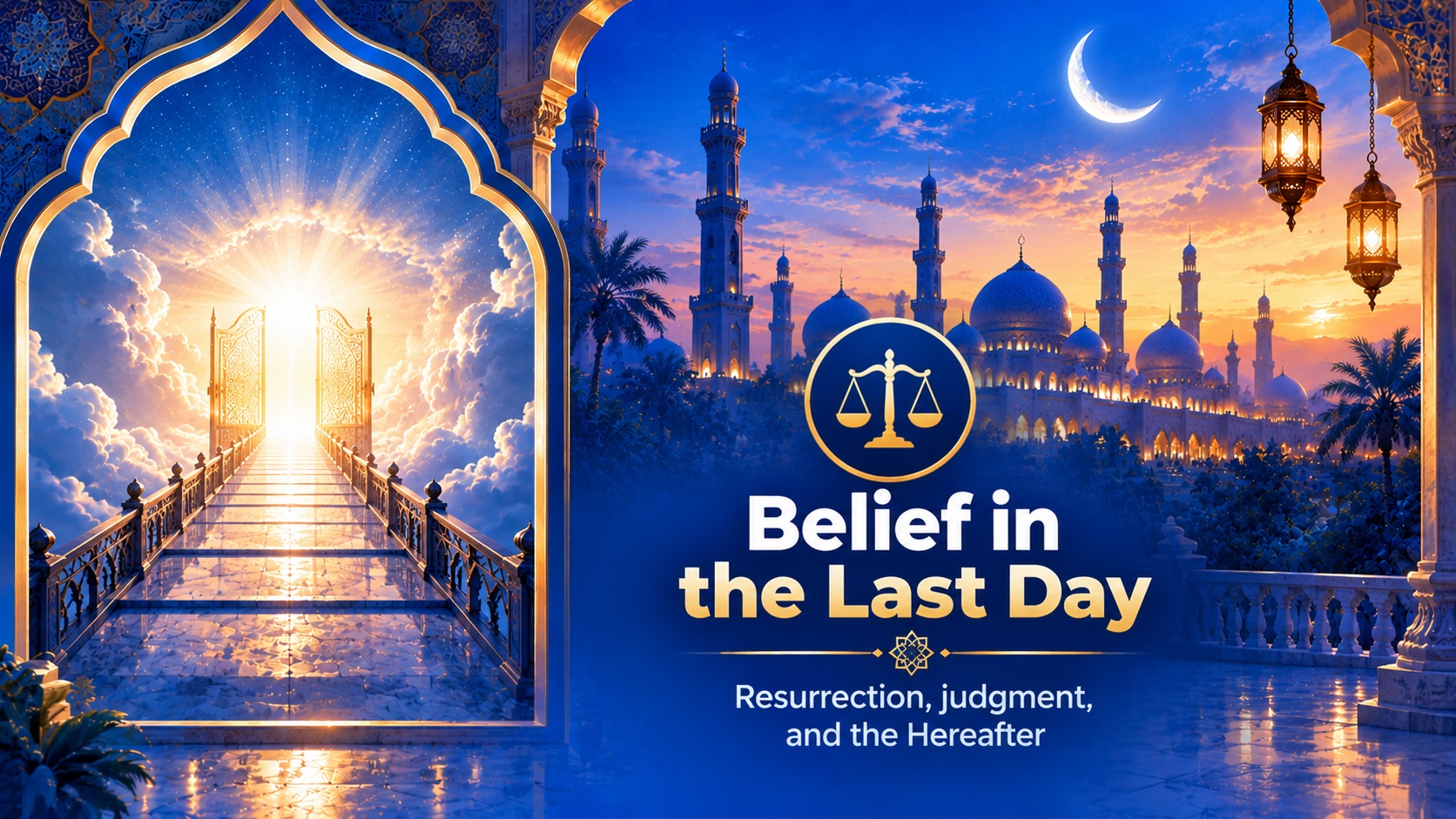
Medical science has improved human health and helped people live longer.
But despite technological progress, death remains part of human existence.
Every person, regardless of wealth, fame, or power, eventually faces it.
Islam teaches that death is not the end. Muslims believe in resurrection, judgment, and the Hereafter.
What Does the Qur’an Say?
Surah Az-Zalzalah (99:7–8)
فَمَن يَعْمَلْ مِثْقَالَ ذَرَّةٍ خَيْرًا يَرَهُۥ
وَمَن يَعْمَلْ مِثْقَالَ ذَرَّةٍ شَرًّا يَرَهُۥ
English translation — Saheeh International:
So whoever does an atom’s weight of good will see it,
And whoever does an atom’s weight of evil will see it.
Reference: Qur’an 99:7–8
A Personal Reflection
Imagine reaching the final moments of your life.
Would your greatest achievement be your wealth, possessions, or professional success?
Or would you remember the people you loved, the kindness you showed, and the good you contributed?
Belief in the Last Day reminds Muslims that actions have consequences beyond worldly recognition.
We cannot control how long we live, but we can take responsibility for how we live.
6. Belief in Divine Decree: Can We Predict Everything?
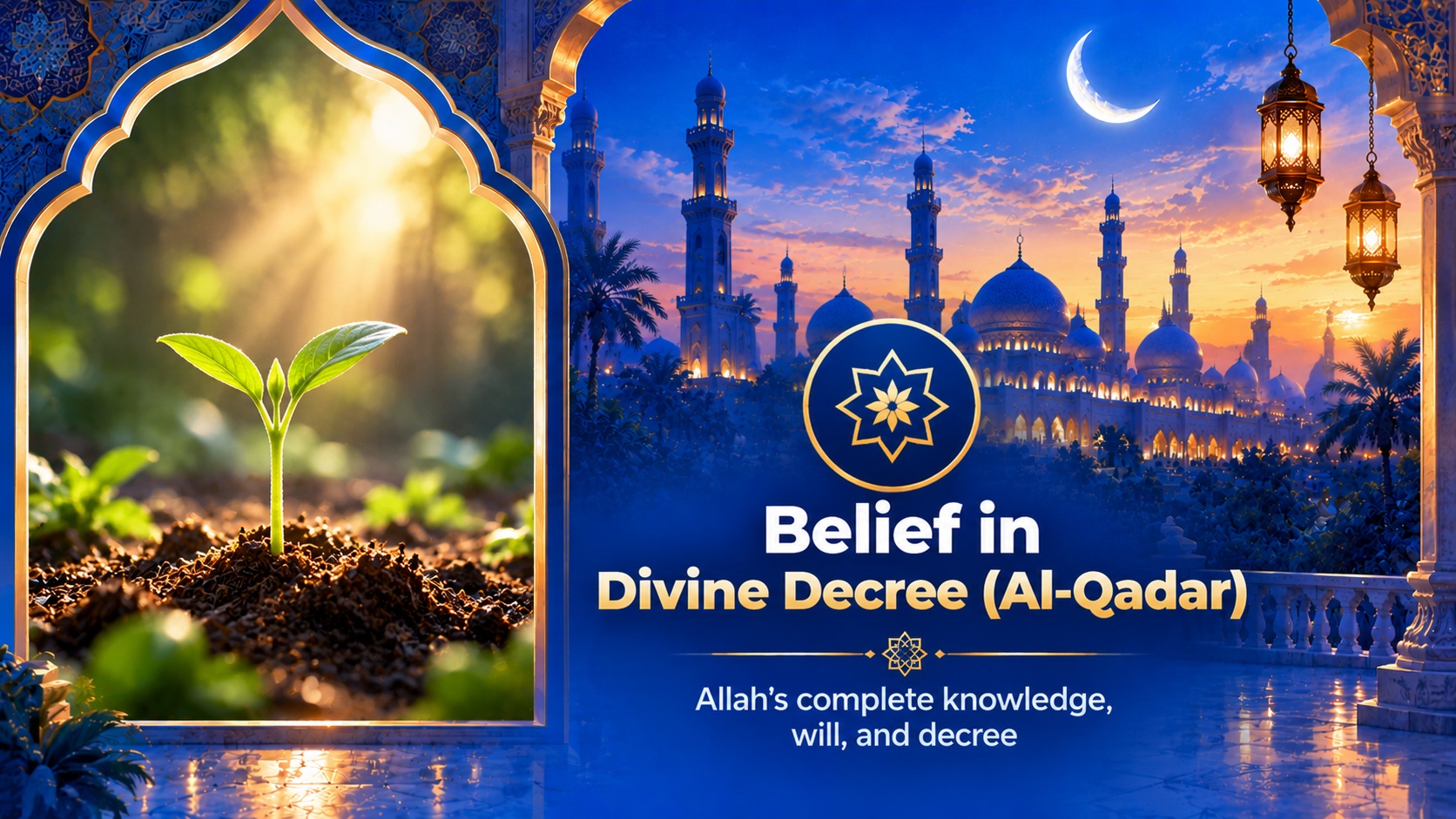
Artificial intelligence can analyze patterns and estimate future outcomes.
Weather forecasting predicts atmospheric conditions. Medical systems assess certain health risks. Other models help people make decisions under uncertainty.
But every prediction has limitations.
Even advanced AI cannot know every future event with certainty.
What Is Al-Qadar?
In Islam, Al-Qadar means divine decree.
Muslims believe that Allah possesses complete knowledge and that nothing occurs outside His will.
Surah Al-Qamar (54:49)
إِنَّا كُلَّ شَىْءٍ خَلَقْنَـٰهُ بِقَدَرٍ
English translation — Saheeh International:
Indeed, all things We created with predestination.
Reference: Qur’an 54:49
What Is the Connection With Active Inference?
In our article Artificial Intelligence (AI) and Islam | Active Inference, we explain how intelligent systems use existing knowledge, predictions, and new information to make decisions.
For example, an AI robot may recognize an object based on previous data. If uncertain, it can gather additional information before acting.
Human beings also use perception, memory, and experience when making decisions.
These systems illustrate the limitations of prediction and knowledge, but they do not scientifically demonstrate divine decree.
In Islamic belief, Allah’s knowledge is complete, while human knowledge remains limited.
The lesson is simple: make sincere efforts, take responsibility, and trust Allah regarding what lies beyond your control.
What Is the Difference Between the Arkn-e-Islam and the Arkan-e-Iman
| Five Pillars of Islam | Six Articles of Faith |
|---|---|
| Known as Arkan-e-Islam | Known as Arkan-e-Iman |
| Foundational religious practices | Essential religious beliefs |
| Include Salah, Zakat, fasting, and Hajj | Include belief in Allah, angels, revelation, prophets, the Last Day, and divine decree |
| Concern acts of worship | Concern foundations of faith |
Both are explained in the Hadith of Jibril.
Read more: Five Pillars of Islam: Why Should Muslims Follow Them?
Why Should Someone Explore Islam?
People explore religion for many reasons.
Some are searching for meaning after experiencing hardship. Others are interested in history, science, philosophy, or spirituality.
Islam presents a worldview centered on the oneness of Allah, worship, justice, mercy, and accountability.
For someone curious about Islam, reading the Qur’an, learning about Prophet Muhammad (peace be upon him), and asking sincere questions can be valuable starting points.
Faith is a personal matter, and understanding a belief before accepting it is important.
Frequently Asked Questions
What does Arkan-e-Iman mean?
Arkan-e-Iman means the foundations or pillars of faith in Islam.
Are all Six Articles of Faith essential in Islam?
Yes. In mainstream Islamic theology, all six are considered essential beliefs of Iman.
Can modern science prove the Six Articles of Faith?
Science investigates the natural world through evidence and observation. The Six Articles of Faith include metaphysical religious beliefs that cannot all be tested scientifically. Scientific discoveries can inspire reflection, but should not be presented as conclusive proof of these beliefs.
What is the purpose of life according to Islam?
Islam teaches that human beings were created to worship Allah.
Reference: Qur’an 51:56
Moral of the Blog: We Have Learned How to Build Intelligent Machines, but Have We Learned How to Live Wisely?
Humanity has created technologies capable of recognizing faces, translating languages, and processing enormous amounts of information.
Yet we still experience love, fear, hope, gratitude, and the desire to understand our existence.
Technology can help us solve problems, but it cannot make every moral or spiritual decision for us.
The Six Articles of Faith encourage Muslims to remember Allah, seek beneficial knowledge, act responsibly, and reflect upon the purpose of life.
For readers exploring Islam, they offer a meaningful introduction to how faith shapes human understanding and behavior.
Perhaps the greatest achievement of human intelligence is not simply discovering how the world works, but learning how to live with wisdom, humility, and compassion.
Conclusion
The Six Articles of Faith explain the foundations of Islamic belief and invite reflection on creation, revelation, responsibility, and destiny.
Modern science continues to expand our understanding of the universe, while questions about ultimate purpose and faith invite further philosophical and spiritual reflection.
Whether you are Muslim or learning about Islam for the first time, understanding these beliefs can offer a deeper perspective on life.
Continue learning, reflect on life, and never stop asking meaningful questions.
About Salah App – Namaz Call Blocker
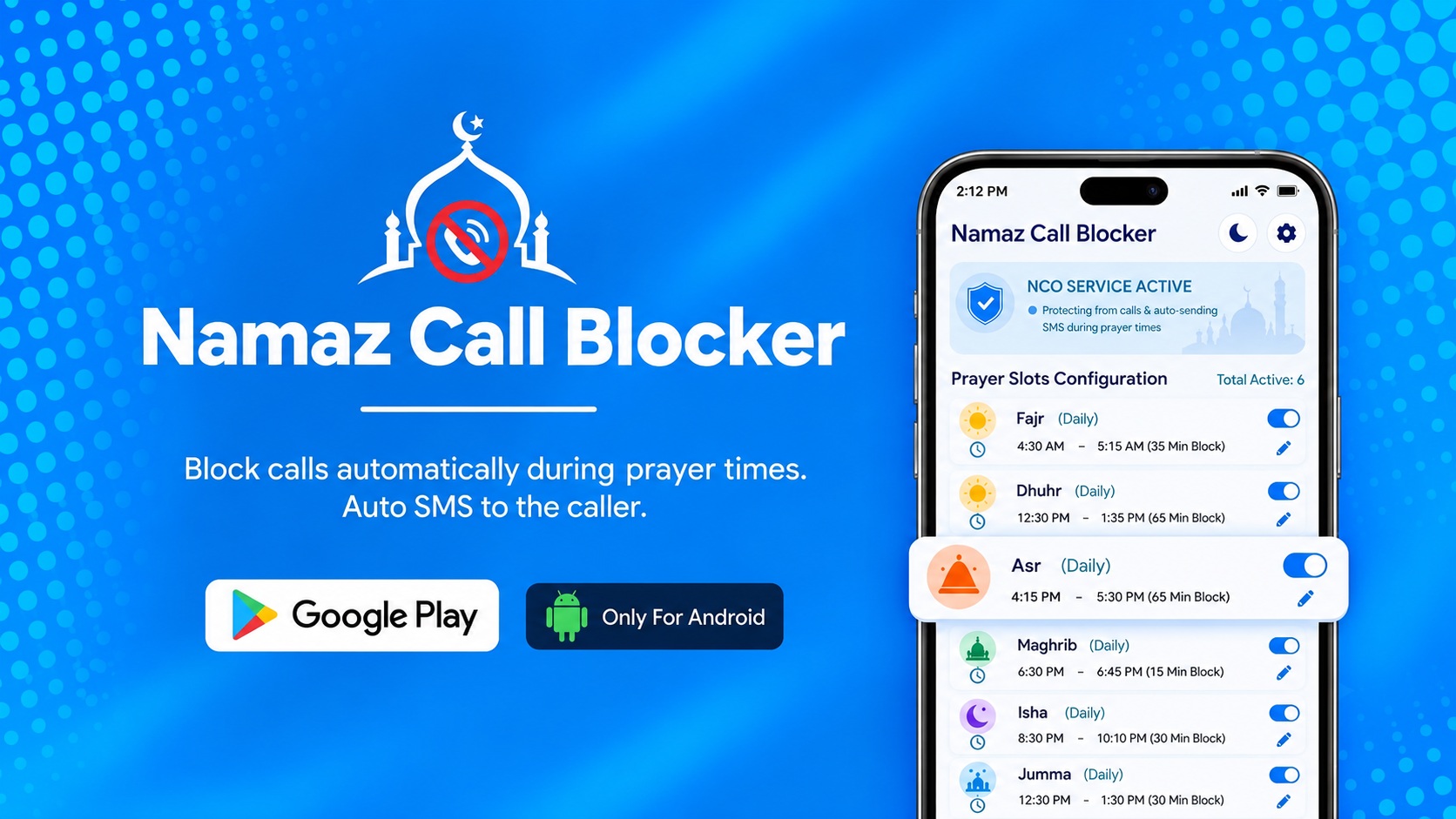
Salah App – Namaz Call Blocker is a free Android application designed to help Muslims avoid incoming-call distractions during Salah.
It offers automatic call rejection, optional SMS responses, silent or vibrate settings, and automatic restoration after scheduled prayer times.
Free to Use | No Internet | No Ads | Your Data Is Safe
Visit: https://namazcallblocker.com
Published by Namaz Call Blocker — Islamic Knowledge Series.
Primary Islamic References
- Sahih Muslim 8a — Hadith of Jibril
- Qur’an 2:285 — Belief and Revelation
- Qur’an 4:136 — Articles of Faith
- Qur’an 112:1 — Oneness of Allah
- Qur’an 38:29 — Reflection on Revelation
- Qur’an 54:49 — Divine Decree
- Qur’an 99:7–8 — Accountability
Qur’an quotations are attributed to Saheeh International. Readers should consult the complete verses and translations in context.