Eid-Milad-un-Nabi: What It Is and Should It Be Celebrated?
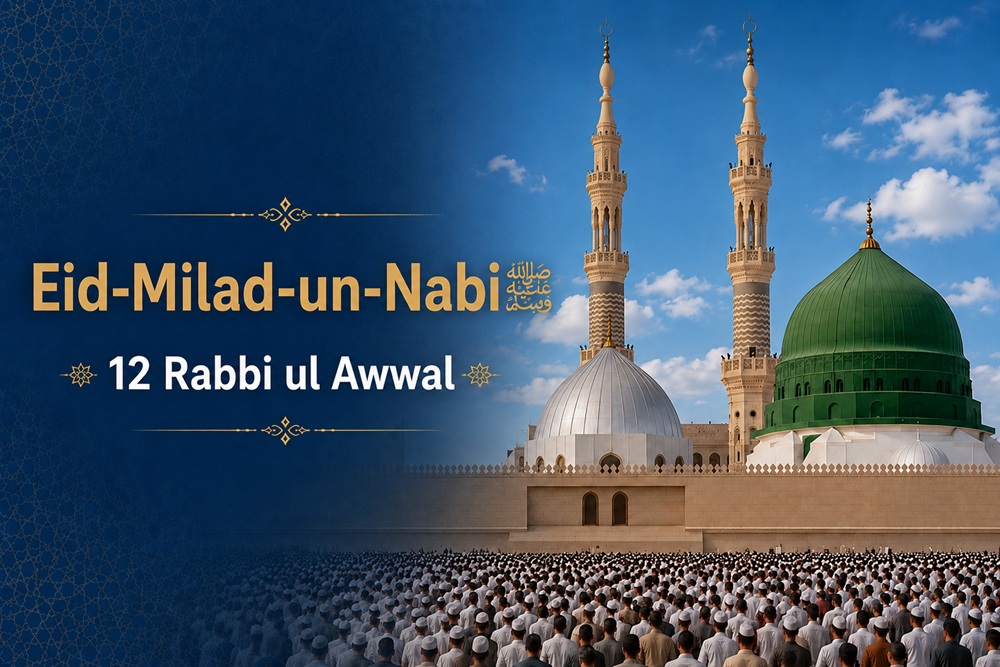
Every year, in the Islamic month of Rabi’ al-Awwal, millions of Muslims around the world observe Eid-Milad-un-Nabi, also known as Mawlid al-Nabi. The day is dedicated to remembering the birth of Prophet Muhammad (Peace Be Upon Him), one of the most significant figures in human history. Yet despite its popularity in many parts of the Muslim world, it remains one of the more debated occasions in Islamic practice. Some communities mark it with great enthusiasm, while others avoid it altogether, citing religious concerns. In this article, we break the topic down into five key points to help you understand what Eid-Milad-un-Nabi really is, and the reasoning behind both sides of the debate.
1. What Is Eid-Milad-un-Nabi?
Eid-Milad-un-Nabi translates roughly to “the festival of the birth of the Prophet.” It commemorates the birth of Prophet Muhammad (Peace Be Upon Him), which, according to widely accepted tradition, took place on the 12th of Rabi’ al-Awwal in the Islamic lunar calendar. Some Shia traditions instead mark the occasion on the 17th of the same month.
Observances differ significantly by region, culture, and school of thought, but commonly include:
- Religious gatherings and lectures, where scholars or community leaders speak about the Prophet’s (Peace Be Upon Him) life, character, teachings, and sacrifices.
- Recitation of devotional poetry (na’at or qasida) composed in praise of the Prophet (Peace Be Upon Him).
- Public processions, especially common in countries like Pakistan, India, Bangladesh, Egypt, and across parts of Africa, often featuring lights, banners, and green flags symbolic of Islam.
- Charity and food distribution, with many families and organizations using the occasion to feed the poor or distribute sweets.
- Decoration of mosques, homes, and streets, sometimes on a scale comparable to how other cultures mark major religious milestones.
For many who observe the day, it is less about treating a specific date as sacred, and more about using the occasion to reconnect with the Prophet’s (Peace Be Upon Him) biography (seerah) and character.
2. The Case For Celebrating It
Those who support observing Mawlid tend to build their argument around a few core ideas:
- It expresses love, not worship. Supporters emphasize that gathering to remember the Prophet’s (Peace Be Upon Him) life is simply an expression of gratitude and love — a sentiment the Quran itself encourages Muslims to hold toward him.
- It has deep historical roots. Advocates point out that Mawlid gatherings have existed in various forms for centuries, and have been endorsed across generations by respected scholars from multiple schools of Islamic jurisprudence, including Shafi’i and Hanafi traditions.
- The individual activities are permissible. Since the gathering typically includes remembrance of God, praise of the Prophet (Peace Be Upon Him), Quranic recitation, and charity — all considered good deeds in Islam — many scholars argue there is nothing inherently objectionable about the occasion itself.
- It serves an educational purpose, especially for younger generations, by keeping the Prophet’s (Peace Be Upon Him) story and teachings alive and relevant in community life.
3. The Case Against Celebrating It
On the other side, many scholars — particularly from Salafi and Wahhabi schools of thought — argue against observing the occasion at all, based on a few key concerns:
- It is viewed as bid’ah (religious innovation). Critics point out that neither the Prophet Muhammad (Peace Be Upon Him) himself, nor his companions, nor the earliest generations of Muslims — often regarded as the most authentic example of practice — ever celebrated his birth in this way. Since the practice emerged later in history, opponents view it as a departure from the original, unaltered form of the religion.
- Islam formally recognizes only two Eids. According to this view, Eid al-Fitr and Eid al-Adha are the only festivals explicitly sanctioned in Islamic teaching, and introducing a third risks blurring the line between religious obligation and cultural addition.
- Concerns about ritual drift. Some scholars worry that certain regional practices around Mawlid have, over time, moved toward excessive veneration of the Prophet (Peace Be Upon Him) — for example, beliefs about his metaphysical presence at gatherings — which could conflict with the core Islamic principle of tawhid, or the oneness of God.
- A precautionary approach to religious practice. Many opposing scholars cite the Prophet’s (Peace Be Upon Him) own teaching that every newly introduced matter in religion is an innovation, and argue it’s safer to avoid adding new observances altogether, however well-intentioned.
4. How Different Muslim Communities View It
Because this is a matter of scholarly interpretation rather than settled consensus, practice varies widely across the Muslim world:
- Barelvi and Sufi-influenced communities, especially across South Asia, North Africa, and Turkey, tend to celebrate Mawlid enthusiastically as a major cultural and spiritual event.
- Salafi communities, including the official religious position in Saudi Arabia, do not observe the occasion and consider it an unsanctioned addition to religious practice.
- Shia communities generally do mark the Prophet’s (Peace Be Upon Him) birth, often combining it with the birth anniversary of the sixth Shia Imam, Ja’far al-Sadiq, on the 17th of Rabi’ al-Awwal.
- Deobandi scholars are notably divided — some permit certain forms of remembrance while cautioning strongly against practices they view as excessive or imitative of other cultures’ celebrations.
5. Should You Celebrate It?
Ultimately, whether to observe Eid-Milad-un-Nabi is a matter of personal religious interpretation rather than a settled, universal ruling. If you’re trying to decide where you stand, a few points may help guide that decision:
- Seek guidance from a qualified scholar within the school of thought you follow, since interpretations genuinely differ.
- Consider intention. Scholars on both sides of the debate generally agree that sincerity and sound belief matter more than the specific form an act of devotion takes.
- Avoid excess. Even among those who support observing Mawlid, most caution against practices that risk conflicting with fundamental Islamic beliefs, such as attributing divine knowledge or qualities to the Prophet (Peace Be Upon Him).
Conclusion
Eid-Milad-un-Nabi remains one of the most visible points of theological diversity within the global Muslim community. For some, it is a joyous, centuries-old tradition that strengthens faith and communal bonds. For others, it is a well-intentioned but unnecessary addition to religious practice, best avoided out of caution. What unites both perspectives, however, is a shared reverence for Prophet Muhammad (Peace Be Upon Him) and a genuine desire to honor his life and legacy. The disagreement, at its core, isn’t about whether he deserves love and respect — every Muslim agrees he does — but how that honor should be expressed within the boundaries of Islamic teaching. For those exploring the topic, the best path forward is thoughtful reflection, sincere intention, and guidance from knowledgeable religious sources.
This article is intended as a general educational overview of differing viewpoints and is not a religious ruling (fatwa). For personal religious guidance, please consult a qualified scholar.