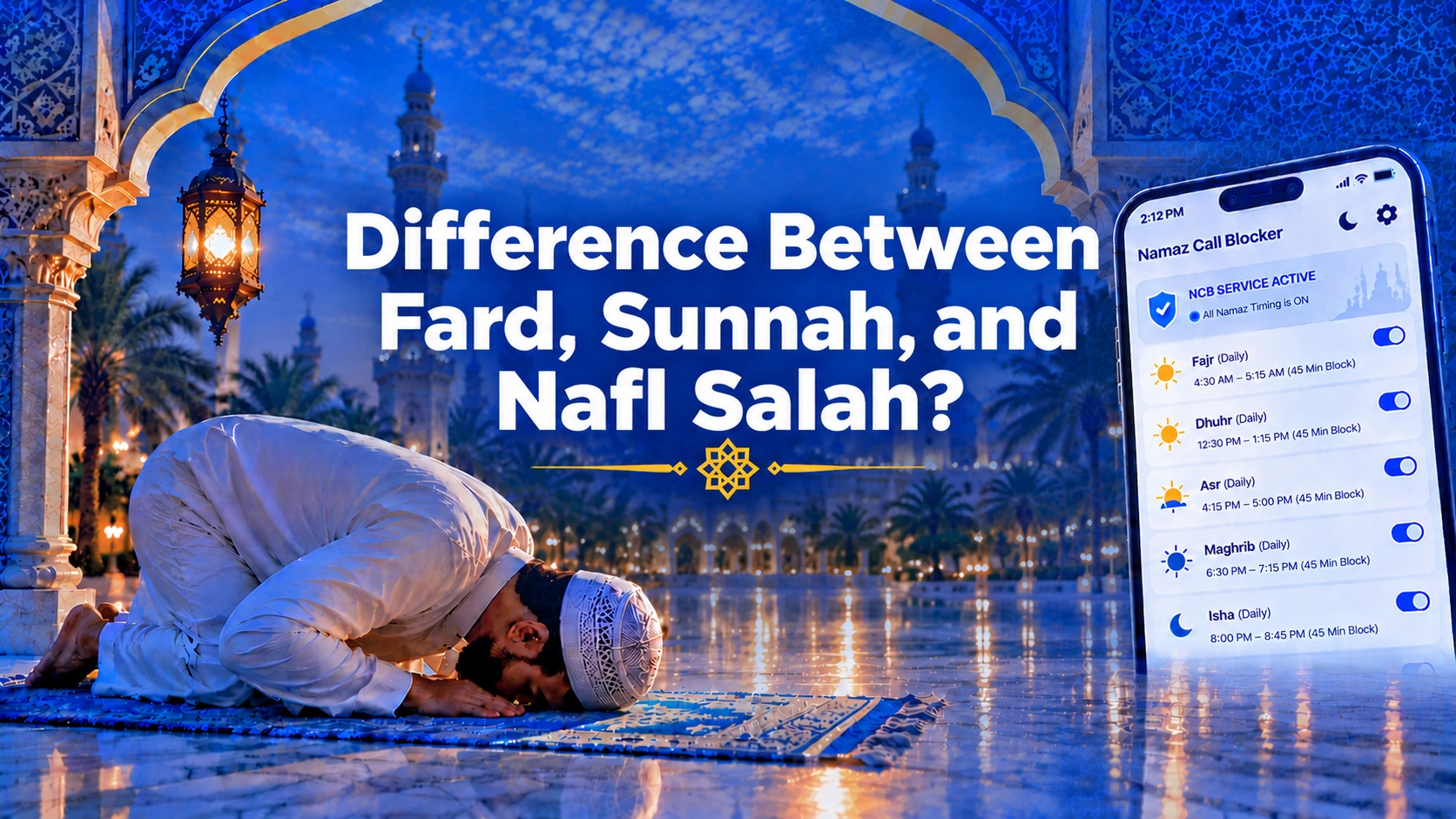
What Is the Difference Between Fard, Sunnah, and Nafl Salah?
Mohd Danish
Founder & Developer
Every day, millions of Muslims perform Salah as an essential part of their relationship with Allah. Some prayers are obligatory, while others are performed to follow the example of Prophet Muhammad ﷺ and seek additional rewards.
If you have ever prayed in a mosque, you may have heard someone say:
“First pray four Sunnah, then four Fard, and finally two Sunnah.”
For someone learning Salah, this can be confusing.
Why are some Rak’ahs called Fard while others are called Sunnah? What does Nafl mean? Are all these prayers equally important? And what happens if someone misses them?
Understanding these differences helps Muslims worship with greater knowledge and confidence.
In this article, we will explore Fard, Sunnah, and Nafl Salah, their importance, examples, Rak’ah counts, and the distinctions made by Islamic scholars.
What Are Fard, Sunnah, and Nafl Salah?
Fard, Sunnah, and Nafl are terms used in Islamic jurisprudence to describe different categories of prayer.
The main difference concerns their religious status and the level of obligation attached to them.
| Type of Salah | Meaning | Religious Status | Examples |
|---|---|---|---|
| Fard (فرض) | Obligatory prayer | Must be performed | Five daily obligatory prayers |
| Sunnah (سنة) | Prayer established through the Prophet’s ﷺ practice | Recommended, with varying emphasis | Sunnah before Fajr and after Dhuhr |
| Nafl (نفل) | Additional voluntary prayer | Voluntary | Extra night prayers, Duha |
These categories are not simply different ways of performing the same prayer. They explain why a prayer is performed and its position within Islamic worship.
An important principle is that obligatory worship takes priority over voluntary worship.
1. What Is Fard Salah in Islam?
Fard Salah is an obligatory prayer that Muslims are required to perform.
The five daily obligatory prayers are among the fundamental acts of worship in Islam.
Allah says in the Holy Qur’an:
Surah An-Nisa (4:103)
Arabic:
إِنَّ الصَّلَاةَ كَانَتْ عَلَى الْمُؤْمِنِينَ كِتَابًا مَوْقُوتًا
English translation — Sahih International (excerpt):
“Indeed, prayer has been decreed upon the believers a decree of specified times.”
Reference: Qur’an 4:103
This verse establishes the importance of performing Salah at its appointed times.
How Many Fard Rak’ahs Are There in Five Daily Prayers?
| Daily Salah | Fard Rak’ahs |
|---|---|
| Fajr | 2 |
| Dhuhr | 4 |
| Asr | 4 |
| Maghrib | 3 |
| Isha | 4 |
| Total | 17 |
These 17 obligatory Rak’ahs form the daily foundation of Salah.
The obligation applies to accountable Muslims, subject to the conditions and exemptions established in Islamic law.
For example, menstruating women are exempt from performing Salah during menstruation, and Islamic law provides accommodations for illness and travel.
What Happens If Someone Misses Fard Salah?
Deliberately neglecting an obligatory prayer without a valid excuse is a serious matter in Islam.
If someone misses Salah because of sleep or forgetfulness, the Sunnah instructs them to perform it when they remember.
Hadith reference: Sahih Muslim 684a
Questions about deliberately missed prayers, making them up and the consequences of abandoning Salah involve additional juristic differences.
A person who has missed prayers should seek repentance, resume regular Salah and consult a qualified scholar about any outstanding obligations.
Why Is Fard Salah So Important?
The five daily prayers are not merely a recommended spiritual routine.
They are an obligation and one of the central practices of Islam.
They create regular opportunities to remember Allah, seek forgiveness and maintain discipline throughout the day.
To explore their deeper meaning, read What Is Salah and Why Is It Important for Muslims?.
2. What Is Sunnah Salah?
Sunnah Salah refers to prayers associated with the established practice and guidance of Prophet Muhammad ﷺ.
Many Sunnah prayers are performed before or after the obligatory prayers.
These regular prayers are commonly called Sunan al-Rawatib.
They are not all classified with the same degree of emphasis.
For example, scholars distinguish between prayers the Prophet ﷺ regularly maintained and other recommended prayers performed less consistently.
What Is Sunnah Mu’akkadah?
Sunnah Mu’akkadah (سنة مؤكدة) means an emphasized Sunnah.
It refers to an act strongly established through the practice of Prophet Muhammad ﷺ.
Examples include the two Sunnah Rak’ahs before Fajr and other regular Sunnah prayers associated with the daily Fard Salah.
The two Sunnah Rak’ahs before Fajr have particular importance.
Prophet Muhammad ﷺ said that the two Rak’ahs before Fajr are better than the world and everything in it.
Reference: Sahih Muslim 725a
This demonstrates the extraordinary virtue of these prayers, although it does not make them Fard.
What Is Sunnah Ghair Mu’akkadah?
Sunnah Ghair Mu’akkadah (سنة غير مؤكدة) means a non-emphasized Sunnah.
In the Hanafi classification, this refers to recommended prayers that are not emphasized to the same degree as Sunnah Mu’akkadah.
Examples commonly include four Rak’ahs before Asr and four before Isha.
A Muslim may receive reward for performing these prayers, but they are not treated as obligatory.
Important: The terms Sunnah Mu’akkadah and Ghair Mu’akkadah are particularly prominent in Hanafi discussions. Other Sunni schools may organize recommended prayers using somewhat different terminology.
3. What Is Nafl Salah?
Nafl Salah is additional voluntary prayer performed beyond obligatory worship.
The word Nafl (نفل) conveys the idea of something additional.
A Muslim may perform voluntary Salah to seek Allah’s pleasure, express gratitude, ask for guidance or spend additional time in worship.
Unlike Fard Salah, Nafl prayers are not generally obligatory.
Examples include:
- Salat al-Duha: Voluntary prayer during the morning.
- Tahajjud: Night prayer, commonly performed after sleeping.
- Additional voluntary Rak’ahs: Prayers performed at permissible times.
- Tahiyyat al-Masjid: Prayer associated with entering a mosque, subject to scholarly details and exceptions.
The categories Sunnah and Nafl sometimes overlap in scholarly usage. A prayer can be voluntary in its legal status while also being established through the Sunnah.
Therefore, it would be inaccurate to suggest that Sunnah and Nafl are always completely separate types of worship.
Why Should Muslims Perform Nafl Salah?
A Hadith Qudsi narrated in Sahih al-Bukhari explains that Allah loves the obligatory deeds performed by His servant, and that the servant continues drawing nearer to Him through additional voluntary deeds.
Reference: Sahih al-Bukhari 6502
This teaches an important principle.
We should first fulfil our obligations, then seek additional closeness to Allah through voluntary worship.
Nafl Salah is an opportunity to strengthen a relationship with Allah beyond the minimum requirements.
4. Fard vs Sunnah vs Nafl Salah: Main Differences
| Question | Fard | Sunnah | Nafl |
|---|---|---|---|
| Is it obligatory? | Yes | Generally no | Generally no |
| Is it rewarded? | Yes | Yes | Yes |
| Is deliberately missing it sinful? | Yes, without valid excuse | Depends on the classification and school; habitual neglect of emphasized Sunnah is treated seriously by some scholars | Generally no |
| Is it associated with the Prophet’s ﷺ practice? | Yes | Yes | Many forms are |
| Can it replace Fard Salah? | Not applicable | No | No |
| Example | 4 Fard of Dhuhr | 2 Sunnah before Fajr | Duha prayer |
Remember: Extra prayers cannot simply be substituted for missed obligatory prayers.
5. How Many Fard, Sunnah, and Nafl Rak’ahs Are There in Each Salah?
This is one of the most common questions among Muslims learning to pray.
The table below shows a commonly taught Hanafi prayer arrangement, familiar in many South Asian communities.
It should not be understood as a universally obligatory Rak’ah schedule for every Sunni school.
| Salah | Before Fard | Fard | After Fard | Additional Prayer |
|---|---|---|---|---|
| Fajr | 2 Sunnah Mu’akkadah | 2 | — | — |
| Dhuhr | 4 Sunnah Mu’akkadah | 4 | 2 Sunnah Mu’akkadah | 2 Nafl commonly offered |
| Asr | 4 Sunnah Ghair Mu’akkadah | 4 | — | — |
| Maghrib | — | 3 | 2 Sunnah Mu’akkadah | 2 Nafl commonly offered |
| Isha | 4 Sunnah Ghair Mu’akkadah | 4 | 2 Sunnah Mu’akkadah | 2 Nafl commonly offered; Witr separately |
Some prayer charts also include further voluntary Rak’ahs after Isha.
Witr requires separate attention: The Hanafi school classifies Witr as Wajib, whereas other major Sunni schools generally classify it as a highly emphasized Sunnah. It should not be casually labeled Fard or ordinary Nafl for every Muslim.
Are There Exactly 12 Sunnah Rak’ahs Every Day?
A well-known authentic Hadith describes the reward for consistently performing twelve voluntary Rak’ahs in addition to the obligatory prayers.
Umm Habibah (may Allah be pleased with her) narrated that Prophet Muhammad ﷺ described a house in Paradise being built for the person who performs twelve such Rak’ahs in a day and night.
Reference: Sahih Muslim 728c
A commonly taught arrangement of these twelve regular Sunnah Rak’ahs is:
| Prayer | Regular Sunnah Rak’ahs |
|---|---|
| Before Fajr | 2 |
| Before Dhuhr | 4 |
| After Dhuhr | 2 |
| After Maghrib | 2 |
| After Isha | 2 |
| Total | 12 |
Other authentic narrations mention arrangements with different counts, including ten regular Rak’ahs. Scholars discuss and reconcile these reports in different ways.
The important lesson is to appreciate the regular Sunnah prayers without treating every additional Rak’ah as obligatory.
6. What Is Wajib Salah, and How Is It Different From Fard?
You may have noticed that many prayer guides also use the word Wajib (واجب).
This is especially common in the Hanafi school.
In Hanafi jurisprudence, Fard and Wajib are distinguished according to the strength and nature of the evidence establishing an obligation.
Both are binding, but they have technical differences.
Other Sunni schools commonly use Fard and Wajib as broadly equivalent terms in many legal discussions.
Example: Witr Prayer
Witr is a night prayer performed after Isha and before Fajr.
The Hanafi school regards Witr as Wajib and normally performs it as three Rak’ahs.
Other major Sunni schools generally regard Witr as a highly emphasized Sunnah, and accepted methods of performing Witr vary.
This is why a prayer chart prepared for one school of jurisprudence should not automatically be presented as the only correct arrangement for all Muslims.
7. Can Sunnah or Nafl Prayers Make Up for Weaknesses in Fard Salah?
An important narration describes the examination of a person’s prayer on the Day of Judgment.
It explains that deficiencies in obligatory prayer may be addressed through voluntary prayers, by Allah’s permission.
Reference: Sunan Abi Dawud 864
This narration encourages Muslims to value voluntary worship.
However, it does not mean that a person may deliberately abandon Fard Salah and expect optional prayers to replace it.
The correct priority remains fulfilling obligatory worship.
8. Should You Pray Fard First or Sunnah First?
The order depends on the particular prayer, its prescribed time and the circumstances.
For example, the two Sunnah Rak’ahs of Fajr are normally offered before the Fard prayer.
At Dhuhr, regular Sunnah prayers are offered both before and after the Fard prayer.
But if someone is about to miss the obligatory prayer, the obligation must be given priority.
When a congregational prayer has already begun, there are specific rulings about starting or continuing voluntary prayers, with some differences among scholars.
It is best to learn these details according to a recognized school of Islamic jurisprudence.
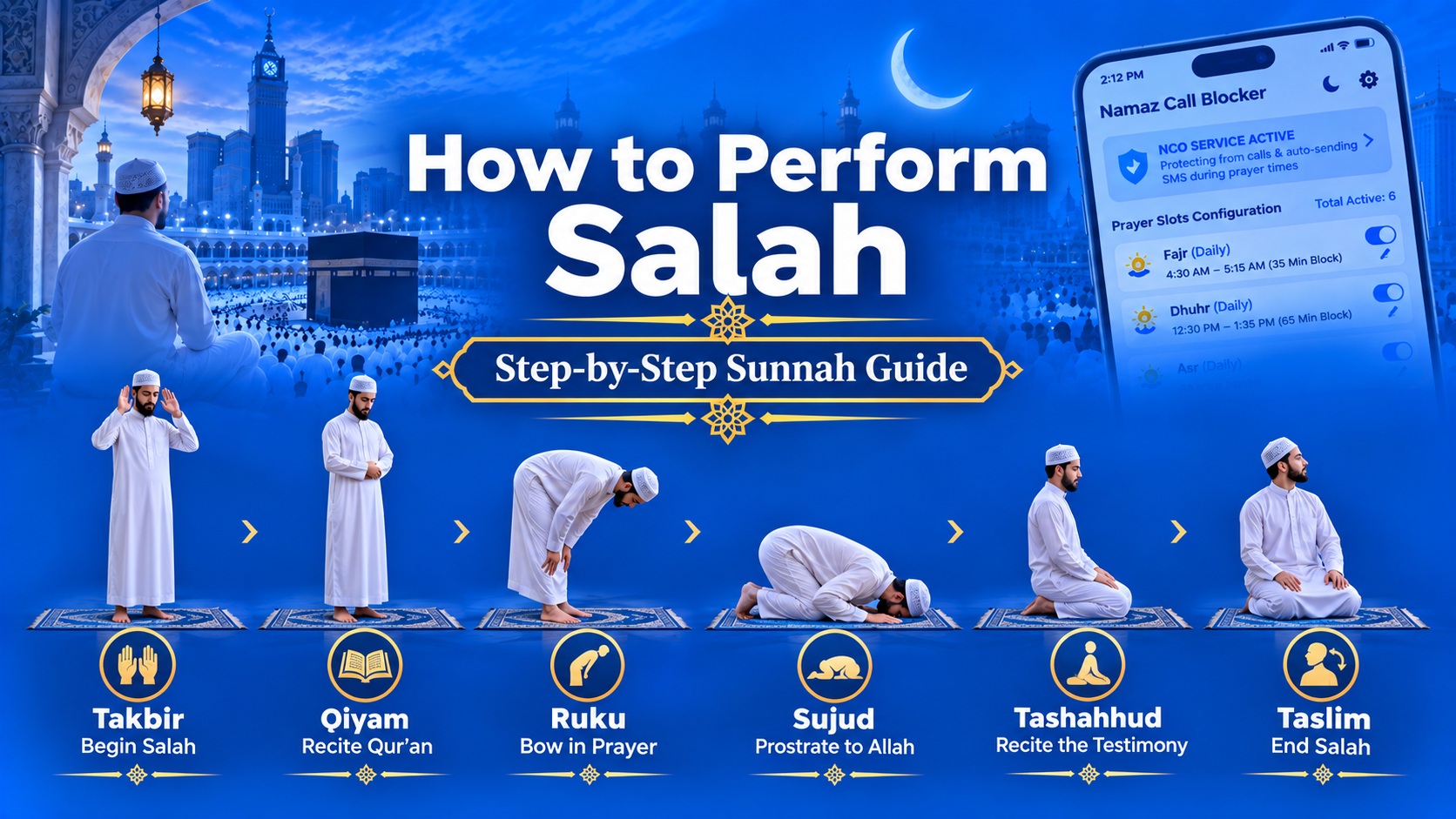
For a practical explanation of the prayer itself, visit How to Perform Salah: Step-by-Step Sunnah Guide.
9. What If You Are New to Salah?
If you are learning to pray, seeing several categories and Rak’ah counts can feel overwhelming.
You may wonder whether you need to memorize every Sunnah and Nafl prayer before beginning.
You do not.
Start by learning the five obligatory prayers, their times, basic recitations and essential movements.
Then gradually learn the emphasized Sunnah prayers and additional voluntary worship.
A useful learning sequence is:
- Understand the importance of the five daily prayers.
- Learn Wudu and the conditions of Salah.
- Learn the obligatory Rak’ahs and how to perform them correctly.
- Become consistent with the Fard prayers.
- Add the regular Sunnah prayers.
- Introduce voluntary prayers as your knowledge and consistency improve.
This sequence is a practical learning suggestion, not a substitute for formal Islamic rulings.
You can begin with Things to Know Before Praying Salah: The Sunnah Way.
10. Why Does Understanding Prayer Categories Matter?
Imagine two people.
One performs many voluntary prayers but regularly neglects the five obligatory prayers.
The other carefully maintains the five daily prayers and gradually adds Sunnah worship.
The second person has understood a fundamental principle: obligatory duties must come first.
This does not mean that voluntary prayers are unimportant.
Rather, each form of worship has its place.
Fard Salah establishes our essential religious responsibility.
Sunnah prayers help us follow the example of Prophet Muhammad ﷺ.
Nafl prayers provide further opportunities for devotion and remembrance.
Together, they can contribute to a disciplined and spiritually meaningful life.
Frequently Asked Questions
1. What is the main difference between Fard, Sunnah, and Nafl Salah?
Fard Salah is obligatory. Sunnah Salah refers to prayers established through the Prophet’s ﷺ practice, often recommended with varying emphasis. Nafl Salah refers to additional voluntary worship. The terms Sunnah and Nafl can overlap in some scholarly classifications.
2. Is Sunnah Salah compulsory?
Generally, Sunnah prayers are not obligatory. However, emphasized Sunnah prayers hold special importance, and some schools strongly discourage regularly neglecting them without a valid reason.
3. Is Nafl Salah compulsory?
No. Nafl Salah is generally voluntary, although some acts commonly grouped with voluntary worship have school-specific rulings.
4. How many Fard Rak’ahs are there daily?
There are 17 Fard Rak’ahs across the five daily prayers: Fajr 2, Dhuhr 4, Asr 4, Maghrib 3 and Isha 4.
5. Can I pray only Fard Salah?
Performing the obligatory prayers fulfils the basic daily prayer obligation when the prayers are valid. However, Muslims are strongly encouraged to follow the Sunnah and perform additional recommended worship. Witr has a separate Wajib classification in Hanafi jurisprudence.
6. Is Witr Fard, Sunnah, or Wajib?
Hanafi scholars classify Witr as Wajib. Other major Sunni schools generally classify it as an emphasized Sunnah.
7. What is the difference between Sunnah Mu’akkadah and Ghair Mu’akkadah?
Sunnah Mu’akkadah is a strongly emphasized Sunnah. Sunnah Ghair Mu’akkadah is recommended but not emphasized to the same degree. These terms are especially common in Hanafi jurisprudence.
8. Is Tahajjud a Nafl prayer?
Yes. Tahajjud is a voluntary night prayer with great spiritual importance.
9. Can Nafl prayers replace missed Fard prayers?
No. Nafl prayers do not automatically discharge outstanding Fard obligations.
10. Which Salah should beginners prioritize?
Beginners should prioritize learning and consistently performing the five obligatory daily prayers, then gradually add Sunnah and Nafl worship.
Explore Our Complete Salah Learning Series
Understanding the categories of Salah is one part of learning how Muslims worship.
These related articles explain the foundations of prayer and preparation.
| Article | Topic |
|---|---|
| Five Pillars of Islam | Why Salah is a foundation of Islam |
| What Is Salah? | Meaning and importance of daily prayer |
| What Is Wudu? | Purification before prayer |
| What Is Ghusl? | When ritual bathing is required |
| What Is Tayammum? | Purification when water cannot be used |
| Things to Know Before Praying Salah | Prayer preparation |
| How to Perform Salah | Step-by-step prayer guidance |
| What Is Jumu’ah? | Friday congregational prayer |
Stay Focused on Your Fard, Sunnah, and Nafl Salah with Namaz Call Blocker

Whether you are performing Fard, Sunnah, or Nafl Salah, one thing remains important: praying with concentration and without unnecessary distractions.
Imagine you are performing your Fard Salah, and suddenly your phone starts ringing. Even if you do not answer the call, the ringtone can disturb your concentration and distract others praying nearby.
This is where Namaz Call Blocker (NCB) can help.
Namaz Call Blocker is a free Android application designed to reduce unwanted phone interruptions during your preferred Salah times.
Conclusion
The difference between Fard, Sunnah, and Nafl Salah becomes easier to understand when we recognize their purpose.
Fard is obligatory. Sunnah follows the established example of the Prophet ﷺ. Nafl is additional voluntary worship.
Each category has an important place in Islamic life.
The five daily Fard prayers remain the foundation. Sunnah and Nafl prayers enrich our worship and offer opportunities for additional reward.
Understanding these distinctions helps us pray with knowledge rather than confusion.
And as we continue learning, we should remember that the goal is not merely to increase the number of prayers we perform, but to strengthen our sincerity, consistency and connection with Allah.
Qur’an and Authentic Hadith References
| Source | Subject |
|---|---|
| Qur’an 4:103 | Prayer at prescribed times |
| Sahih Muslim 684a | Prayer missed through sleep or forgetfulness |
| Sahih Muslim 725a | Virtue of the two Sunnah Rak’ahs before Fajr |
| Sahih Muslim 728a–c | Virtue of twelve regular voluntary Rak’ahs |
| Sahih al-Bukhari 6502 | Obligatory and voluntary deeds |
| Sunan Abi Dawud 864 | Voluntary prayer and deficiencies in obligatory prayer |
Educational note: Prayer classifications and certain Rak’ah arrangements differ among recognized Islamic schools of jurisprudence. The daily Rak’ah example above follows a commonly taught Hanafi arrangement, with important differences identified. Consult a qualified scholar for rulings applicable to your circumstances.
Published by Namaz Call Blocker — Salah App for Android